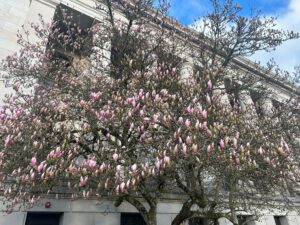
The “Sine Die” Tree on Monday, March 9
(Photo Courtesy: Erica Hallock)
Sine Die Trivia!
In which decade did the “Sine Die” tree earn its nickname?

What Went Down During the Final Week?
Final Supplemental Budget Details Made Public
On Wednesday, March 11, budget writers released the Operating and Capital budget compromise details. Because the proposal is a conference report, it is not eligible for further amendment and must be approved by an up or down vote by both the Senate and the House. Both bodies approved the Operating and Capital budgets prior to adjourning Sine Die on Thursday, March 12.
On Thursday, March 12, Start Early Washington sent out a Special Edition of Notes From Olympia containing a summary of early learning related budget details. We will update this information following the Governor’s action on the budgets.
In terms of the overall 2025-27 Supplemental Operating budget, it:
- Appropriates $80.2 billion in General Fund dollars subject to the Outlook (NGF-O);
- Reduces Working Connections Child Care and Transition to Kindergarten state funding by $181.8 million for the 2025-27 biennium;
- Invests just over $1 billion to cover the state’s tort liability;
- Transfers $880 million from the Budget Stabilization Account to the state General Fund;
- Deposits $394.6 million in capital gains tax revenue in the General Fund rather than distributing it to the School Construction Account; and
- Leaves a projected ending balance for the 2025-27 biennium of $231.0 million NGF-O and $1.3 billion in total reserves.
Millionaire’s Tax
After nearly 25 hours of debate – the longest in recent memory – the House approved ESSB 6346 (Pedersen), the millionaire’s tax, on Tuesday, March 10. The marathon debate included consideration of 79 proposed amendments, only six of which were adopted.
Read the Washington State Standard’s in-depth coverage of this momentous event.
ESSB 6346 returned to the Senate for concurrence in House amendments on March 11. Following a 27-21 vote to affirm the amendments taken in the House, the bill went to Governor Ferguson for his consideration. The Governor has publicly stated his intention to sign the legislation in its current form.
Early Learning Legislation Crystalizes
In the last few days of the 2026 legislative session, the Senate and the House finalized their negotiations on Transition to Kindergarten and Working Connections Child Care policies that were Necessary to Implement the Budget, or “NTIB.”
To get the latest status update on bills as of Sine Die, check out Start Early’s bill tracker. We will release a final tracker after Governor Ferguson concludes his action on bills.
Working Connections Child Care. On Tuesday, March 10, the Senate Ways and Means Committee adopted amendments to SHB 2689 (Gregerson) which makes statutory changes to the Working Connections Child Care (WCCC) program needed to implement budget savings. See the March 6 Notes From Olympia for the broader summary of the legislation.
The March 10 adopted amendments clarified direction on two issues – WCCC attendance policy and required provider response rate for the biennial market rate survey. In summary, the amendments do the following:
- Attendance Policy*:
- If a child attends 16 or more days in a calendar month, the provider is paid for the entire month
- If a child attends between 9-15 days in a calendar month, the provider is paid for 15 days
- If a child attends between 1-8 days in a calendar month, the provider is paid for 11 days
*Presumes full-time authorization
- Required Market Rate Survey Response Rate. Starting with the 2028 Market Rate Survey, each child care subsidy rate region must achieve a provider response rate of at least 40 percent, and also be greater than the response rate for that region in the market rate survey in the prior even-numbered year in order for the results from the survey to be considered valid for the purpose of informing subsidy base rate increases. Further, when the response rate in a region achieves 65 percent or greater, a minimum of 65 percent must be maintained in subsequent surveys to be considered valid.
The full Senate approved SHB 2689 on March 11 by a 33-16 vote and the House concurred in the Senate amendments on March 11 by a 51-45 vote. The bill now moves to Governor Ferguson for his consideration.
Transition to Kindergarten. On Monday, March 9, the House Appropriations Committee adopted amendments to ESSB 6260 (Wellman), an overarching education bill that contained significant changes to Transition to Kindergarten (TTK). On Wednesday, March 11, an amendment adopted on the House Floor further refined the state’s approach to TTK.
The amendments adopted in the past week meld the Senate and House approaches to TTK by:
- Directing the Office of the Superintendent of Public Instruction (OSPI) to prioritize funding for existing programs that serve students who:
- qualify for free or reduced-price meals or have a household income at or below 185 percent of the federal poverty level and lack access to licensed child care;
- are eligible, but not scheduled for, enrollment in ECEAP or Head Start;
- are eligible for or receiving special education in accordance with the federal individuals with disabilities education act; or
- are English learners or multilingual learners.
- Requiring OSPI to prioritize funding for existing TTK programs serving the specific population listed above before providing funding for new programs located within extreme child care access deserts.
- Authorizing school districts to charge sliding scale fees for enrollment in a TTK program, except to eligible for but not yet placed in ECEAP or head start programs or children with disabilities.
- Requiring, beginning June 30, 2026, and annually thereafter, OSPI to report to the Office of the Governor and the appropriate committees of the legislature on the planned TTK program slot allotment for the upcoming school year. The report must include the following information for each school district, charter school, and state-tribal education compact school that will receive funding for the program during the upcoming school year: (a) The number of program slots funded; (b) The percentage of students eligible for free or reduced-price meals during the previous school year; and (c) Whether the school district, charter school, or state-tribal education compact school is located within, or includes a zip code defined as, an extreme child care access desert as determined by DCYF.
The House approved ESSB 6260 on March 11 by a 50-47 vote and the Senate concurred in House amendments on March 12 on a 26-23 vote, sending the bill to Governor Ferguson for his consideration.
Bill Action Moves to the Governor’s Office
Even though a bill may have passed through all of the legislative steps, it is not considered law until it receives the Governor’s signature. We are at the stage of legislative session where the Governor has 20 days to act upon a bill being delivered to his desk. Sundays are not counted as part of these 20 days, but Saturdays and holidays do count. This year, April 4 represents the final day for Governor Ferguson to act on bills.
You can follow the Governor’s Bill Action page on his website for the bill signing/veto schedule.
Washington state governors have the authority to sign, veto or partially veto bills. Our state does not provide for line-item vetoes, but does allow governors to veto individual sections of a bill. Additionally, if the specified time period elapses without action taken by a governor, the bill becomes law.
I worked in another state in the last 1990s and that governor intended to veto a bill and a staff member accidentally left the veto message on the copier. Because the veto message was never officially filed, the bill went into law. Oopsie.
Trivia Answer: the 1960s
The “Sine Die” tree is a saucer magnolia located on the southwest corner of the Legislative Building, near the entrance to the gift shop. The tree typically blooms in March, around the time the Legislature is scheduled to adjourn.
In the 1960s, Jack Pyle, a reporter for the Tacoma News Tribune, anointed the tree with its now famous name and it soon became legend that when it blossoms, it is time for the Legislature to conclude its business and for everyone to head out of dodge. Does the Legislature always heed the Sine Die tree’s directive? Unfortunately, not.
The current tree that many of us have longingly viewed in the past days, hoping to see blooms, is not the original “Sine Die” tree. The original tree was accidentally cut down in 1975 during sidewalk construction. (Warranting the second “oopsie” of this newsletter).
If you are a dendrophile (which means lover of trees), check out this video narrated by former State Senator Karen Fraser of the 22nd Legislative District (which includes the Capitol campus). Senator Fraser provides great background on not only the Sine Die tree, but you also get to see some great pictures from her illustrious career. Definitely worth a watch!
It’s Interim for Notes From Olympia, Too!
This edition marks the end of our weekly Notes From Olympia. Following the Governor’s actions on the budget and bills, we will send out the first of our interim editions. That edition will also include a short survey where we will seek your feedback on how we can make this a more useful tool for readers.
If you have newsletter topics you would like us to cover, send them our way! In particular, we are also always on the lookout for Trivia suggestions.
For now, get some rest and thanks for reading!