ESSB 6260 (Wellman). A bill that includes a number of funding adjustments to the K-12 system, ESSB 6260 also addresses the Transition to Kindergarten (TTK) program. Specifically, ESSB 6260:
- Directs OSPI to establish a criteria to prioritize school districts with existing TTK programs and those identified as lacking available early learning programs when developing rules related to the allocation of state funds for TTK.
- Specifies that rules adopted for TTK must include requirements for authorizing collection of tuition or fees.
- Specifies that funding for TTK program is limited to the amount specified in the omnibus appropriations act.
ESSB 6260 narrowly passed the Senate 25-24 on March 3 and was scheduled for a public hearing in the House Appropriations Committee on March 5 at the time this edition was written with an executive session (vote) scheduled for March 9.
Senate and House Pass Respective Budgets – on to Conference Committee!
Over the span of February 27-28, the Senate and House passed their respective Operating, Capital and Transportation budgets. A couple of notes – the hyperlinks provided herein will take you to the Operating budget landing pages and, as of this writing, the House has not passed its Capital Budget which is a technicality. I am not reading anything in to that.
Start Early Washington’s budget comparison document has been updated to include amendments adopted throughout the process. Once the final budget is adopted, we will update this document to reflect the final conference report and send out a Special Edition of Notes From Olympia with our updated analysis.
This week, the respective chambers appointed conference committee members to resolve the differences between the Senate and House budget approaches. This step was procedural as budget negotiations were already underway.
What Can we Expect for the Final Week of Session? Beyond the Unexpected!
You might be asking what happens in the final six days if non-NTIB bills have already passed out of the opposite chamber or are considered “dead.” And, most importantly, all of the food days have concluded!
Aside from expecting the unexpected, we can anticipate the final six days to include:
- Finalization of Budgets. Akin to white smoke at the Vatican announcing the decision for a new Pope, any day now email inboxes throughout the Capitol Campus will fill with the long awaited notice that a Conference Committee meeting has been scheduled for a report on ESSB 5998, the 2025-27 Supplemental Budget vehicle. At that point, we will know a budget deal has been struck. From there, advocates will anxiously hit refresh, refresh, refresh to learn if they were successful in securing or preserving funding for their program.
- Watch How Quickly NTIB Bills Can Move! As previously mentioned, NTIB bills are not subject to cutoff deadlines. Because NTIB bills incorporate budget deals, it is important to relieve these bills of the budget deadlines. We can expect the scheduling of committee meetings “on the fly” over the remainder of the legislative session to catch these NTIB bills. The descriptions above regarding SHB 2689 and ESSB 6260 are prime examples of NTIB bills zipping through the process to ensure statutory changes to implement budget decisions.
- “Concurrence Process.” Bills that were amended in the opposite chamber must return to their chamber of origin for that body to “concur” with amendments. Concurrence bills are considered by an up or down vote. If the originating body disagrees with the amendments made in the opposite chamber, they can ask the opposite chamber to “recede” in their amendments. If the opposite chamber refuses to recede, a conference committee is appointed to resolve the differences. If the conference committee reaches resolution, that conference report is presented to both chambers for an up or down vote. If they cannot come to resolution, the bill dies. The Legislature only has so much capacity for bills to go to conference committee, so they must weigh which bills receive that level of attention.
In addition to these anticipated actions, there will no doubt be unanticipated drama that will cause tempers to flare and blood pressure to rise. In short, the typical end of session theatrics.
As a reminder, each Thursday, Start Early Washington updates its bill tracker with the latest information on bills we are following. If we have missed any bills of interest, please reach out and flag them for us!
Trivia Answer!
House of Representative members and their staff must begin moving out of the John L. O’Brien building the day after Sine Die on March 13! The reality of movers coming serves as a strong incentive to wrap budget negotiations and legislative action on time so House members can pack up and move out as scheduled.
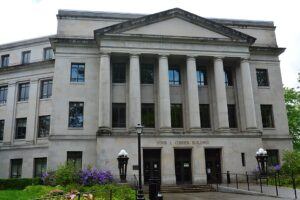
(Photo Courtesy: WikiMedia Commons)
As part of the Legislative Campus Modernization (LCM) Project, the third and fourth floors of the John L. O’Brien (JLOB) Building are being remodeled with work expected to be finished before the beginning of the 2027 legislative session.
The Department of Enterprise Services (DES), the agency leading the LCM Project, cites that the interior design and locations of legislative assistant workstations led to overcrowding when constituents visit their representatives during session, which compromises access, security and privacy.
DES also cites there is demand for additional hearing space, caucus rooms, space for interns and additional session staff, and storage space to support legislative functions of state government.
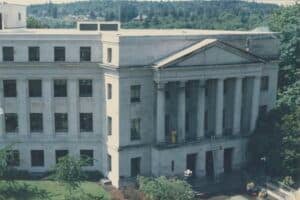
Two workers can be seen working on the facade of the then Public Health Building, in 1988 just before it was renamed the John L. O’Brien Building
(Photo Courtesy: Washington State Archives)
JLOB was first constructed in 1940 and last renovated in 2014. The building has had various renovation and revitalization work over the decades since its initial construction. You can watch a fun montage of the 2009 renovation work on YouTube.
We will hopefully have exciting new spaces to explore next session as both the JLOB renovations and the Pritchard Rehabilitation and Expansion Project are expected to be completed prior to 2027 legislative session. My fingers are crossed that we might finally have some more places to sit, charge our devices, and maybe even space to meet with one another if we’re lucky!
To keep up on the LCM Project, you can sign up for weekly updates from DES here.
Sources
John L. O’Brien Building – Washington State Capitol Campus
Legislative Campus Modernization Project – Department of Enterprise Services
The Historic John L. O’Brien Building – FORMA Construction
Joel Pritchard Building – Department of Enterprise Services