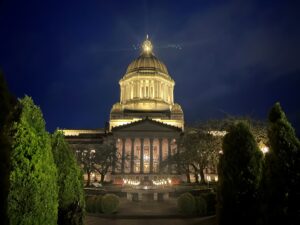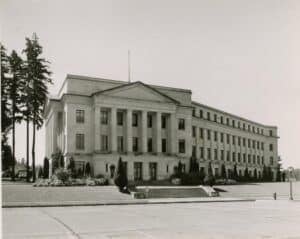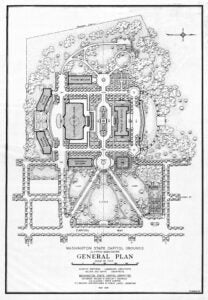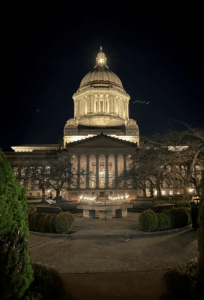
The Campus Looking Lovely on a Sunny Sunday
(Photo Courtesy: Erica Hallock)
Trivia!
How many kinds of pollinators are on the Capitol campus?
Highlights of the Week
Revenue Forecast
On Tuesday, February 16, the Washington State Economic and Revenue Forecast Council met to receive the latest Revenue Forecast from the State Economist, Dave Reich. Because we are all in need of good news, I will cut to the chase:
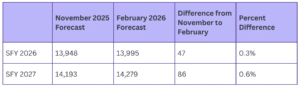
- The forecast of funds subject to the budget outlook for the 2025-27 biennium increased by $827 million and
- The forecast of funds subject to the budget outlook for the 2027-29 biennium increased by $1.028 billion.
Reasons for the improved economic outlook since the November 2025 forecast include improved personal income and employment. We are also starting to see revenue come into the state’s coffers from the tax policies adopted by the Legislature during the 2025 legislative session.
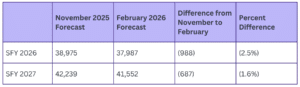
Forecasted total revenue for the 2025-27 biennium is projected at $75.276 billion, a 12.1% increase over the 2023-25 biennium. For the 2027-29 biennium, forecasted total revenue is expected to come in at $80.381 billion, a 6.8% increase over the 2025-27 biennium.
For the first time, we are seeing initial forecasted total revenue for the 2029-31 biennium, with revenue projected to total $86.568 billion, a 7.7% increase over the 2027-29 biennium.
Impact on State Budget Gap. My mind immediately went to the question of how much this increased revenue helps with the state’s budget gap? The short answer is that it does. But, let’s get a bit more specific.
At the December “Committee Days,” House Appropriations non-partisan staff estimated a negative Near General Fund ending fund balance for the 2025-27 biennium of -$1.519 billion (and a negative ending fund balance of -$4.3 billion for the four-year outlook). This estimate took into account Maintenance Level adjustments (the estimated budget needed to maintain current program service levels, accounting for caseload, enrollment and inflation) as well as the November 2025 Revenue Forecast.
With this positive $827.4 million revenue gain from the February 2026 Revenue Forecast, part of the budget gap shrinks to $691.6 million. Please note this number is not a complete reflection of the budget gap because it does not include increased costs associated with the February caseload forecast nor any costs associated with new policies under consideration by the Legislature this session.
A Final Note. Because our state’s employment growth remains lower than 1%, the Legislature is able to take two actions. First, they are able to draw funds from the state’s Budget Stabilization Account with a simple majority vote. Second, they are able to opt out of the four-year balanced budget requirement. Given that the state still faces a significant gap in the four-year outlook, the Legislature has the option of balancing the budget for the 2025-27 biennium only, rather than balancing through the 2027-29 biennium. This is the same approach Governor Ferguson took when he proposed his Supplemental Budget back in December.
Senate Previews Budget Approaches to Working Connections Child Care and Transition to Kindergarten
This week, Senate budget writers previewed their budget response for Working Connections Child Care and Transition to Kindergarten through introduction of SB 6353 (Robinson) and proposed amendments to SB 6260 (Wellman), respectively.
Following are summaries of key provisions of the bills:
SB 6260 (Wellman). This is a larger education related bill. The provisions related to Transition to Kindergarten (TTK) include:
- Tying state-funded TTK enrollment to funding provided in the budget;
- Basing state-funded TTK eligibility at free or reduced lunch or household income or below 185% of the Federal Poverty Level; and
- Allowing schools to supplement state-funded TTK with local levy funds, tuition payments or other resources.
SB 6353 (Robinson). This bill relates to Working Connections Child Care and includes the following provisions:
- Maintains income eligibility at 60% of State Median Income, removing increasing eligibility increases provided in the out-years through the Fair Start for Kids Act.
- Changes the attendance policy for child care centers beginning October 1, 2026, and signals a change for all providers beginning July 1, 2027.
- Under the new system, if a child attends at least one day within a 15-day period, the provider is paid for 15 days. The provider is then paid a daily payment for each additional day the child attends beyond the 15 days within a month.
- An example: If a child attends 3 days in a month, the provider would be paid for 15 days. If a child attends 19 days in a month, the provider would be paid for 19 days.
- Signals a rebasing of all child care provider rates to the 75th percentile of market rate as of July 1, 2027. Both child care centers and family child care homes would continue to be paid at the 85th percentile of the market rate for the 2026-27 fiscal year.
- Makes references to the child care cost methodology statute Washington State RCW 43.216.829 to align with ESSB 5500 (Alvarado) which is working its way through the legislative process this session.
- Specifies that beginning July 1, 2026, providers may not receive a child care subsidy rate that is different than the rate for the subsidy region in which the provider is located. This impacts four counties – Benton, Clark, Walla Walla and Whitman.
- Specifies the scope of Family Child Care bargaining. (See the bill for a specific list).
- Repeals authority for prospective payments.
- Contains an emergency clause which would make the act take effect upon the Governor’s signature.
Both bills had public hearings in the Senate Ways and Means Committee last night, February 19. Because they are Necessary to Implement the Budget, or NTIB, they are not subject to cutoff deadlines. As of this writing, fiscal notes are not available. I would expect to see cost details when the Senate operating budget is released.
House of Origin Cutoff Was on Tuesday – “5:00 Bills”?
Good thing I’m not a gambler because last week I incorrectly guessed the Senate’s “5:00 bill” on the House of Origin Cutoff would be ESSB 6346 (Pedersen), the “Millionaire’s Tax.” Instead, the Senate ran ESSB 6346 on Monday, February 16. And, after lengthy debate, the Senate passed ESSB 6346 by a 27-22 vote, with three Democrats (Senators Cortes, Krishnadasan and Hansen) joining the Senate Republican Caucus in opposing the bill.
Bill proponents spoke to the state’s antiquated tax code; the need to fully fund core services such as health care, education and child care; and support from constituents for this action. It is scheduled for a public hearing in the House Finance Committee on February 24 and executive session (vote) on February 27.
As noted in last week’s newsletter, legislative leadership often schedules controversial bills to run as the “5:00 bills” because if debate starts prior to the clock striking 5:00 p.m., it can go on all night. This year, the “5:00 bill” in the Senate was SB 5360 (Trudeau) relating to environmental crimes, and the House’s “5:00 bill” was HB 2389 (Cortes) relating to Juvenile Rehabilitation.
Both chambers experienced some amount of drama with Senate Minority Floor Leader Shelly Short successfully deploying a parliamentary procedure close enough to the 5:00 hour requiring the clerk to read aloud a bill in its entirety. This action ate up time, preventing the Senate from taking up several bills. The Senate then went “at ease” for a few hours to figure out if they could return to consider the other bills they had hoped to get to prior to their 5:00 bill. Later in the evening, Senate Majority Floor Leader Marcus Riccelli returned to the Floor to formally adjourn the body without further action or debate.
Over in the House, there had been hallway chatter throughout the day as to whether HB 2389 would be the “5:00 bill” given questions over whether the bill had sufficient support for passage. Immediately after taking the bill up prior to 5:00 p.m., the House Democrats and Republicans went to their respective caucuses where they stayed for hours. Somewhere after 7:00 p.m., House Assistant Speaker Pro Tempore Clyde Shavers returned to the rostrum to adjourn the House. The body never debated nor voted on HB 2389.
Move over Shrinking and The Pitt, the real drama is in the Legislative Building.
Quick Trip Back to Policy Committees – This Time in the Other Chamber
During a short session, there’s barely time to take a breath before the next cutoff is bearing down. Following the Tuesday House of Origin cutoff, policy committees returned to action first thing Wednesday morning to consider bills passed by the opposing chamber.
In recognition that the number of bills still in play is waning, the Policy Committee Cutoff in the Opposite Chamber will come quickly – next Wednesday, February 25.
This is where it comes in handy to have a “companion bill” in the opposite chamber as it increases the odds the opposing policy committee has already considered the merits and arguments for the bill. I’m working on a bill that was able to skip a public hearing in the opposing chamber and went directly to executive session for consideration because that policy committee already heard and voted to approve the House bill’s Senate companion. Having that ability to “Skip Go and Collect $200” is a benefit in a short session.
As a reminder, each Thursday, Start Early Washington updates its bill tracker with the latest information on bills we are following. If we have missed any bills of interest, please reach out and flag them for us!
What’s on Deck for Next Week?
House and Senate Budget Releases
In addition to the various free food days, budget release days are the most highly anticipated days in Olympia. We do expect the Senate and House to both release their Operating budget proposals later in the afternoon on Sunday, February 22. (This place really has no sense of boundaries of work/life balance, I tell you!). We expect the Capital budget proposals to be released the day after.
Both The Senate Ways and Means and House Appropriations Committees will hold public hearings to receive public feedback on their Operating Budget proposals on Monday, February 23 starting at 4 p.m.
Start Early Washington plans to release a special edition of Notes From Olympia early next week containing our analysis of the Senate and House approaches to early learning in the Operating and Capital budgets. Keep a lookout for an email containing this information.
Opposite Chamber Policy Cutoff & Fast Fiscal Review
Despite the focus on the Senate and House budget releases, work continues on bills.
As mentioned above, the Policy Committee Cutoff in the Opposite Chamber is next Wednesday, February 25. From there, the Senate Ways and Means and House Appropriations Committees will do a final review and vote on bills with fiscal impacts prior to the March 2 Opposite Chamber Fiscal Committee Cutoff. Phew!!
A Quick Look at Upcoming Key Dates*
- February 22: Public Release of Senate and House Operating Budgets
- February 23: Public Hearing on Senate and House Operating Budgets/Public Release of Senate and House Capital Budgets
- February 24: Public Hearing on Senate and House Capital Budgets
- February 25: Opposite Chamber Policy Committee Cutoff/Executive Action on Senate and House Operating Budgets
- February 26: Executive Action on Senate and House Capital Budgets
- February 27: Floor Action on Senate Operating Budget
- February 28: Floor Action on House Operating Budget
- March 2: Opposite Chamber Fiscal Committee Cutoff
- March 6: Opposite House Cutoff (Deadline for non-NTIB bills to pass out of opposite Chamber)
- March 12: SINE DIE!
*Budget dates are subject to change

Dairy Day Does Not Disappoint
Thanks for the Post Cutoff Pick Me Up!
(Photo Courtesy: Erica Hallock)
Trivia Answer!
There are at least 7 different kinds of pollinators on campus. Yes, pollinators, not polluters. Polluters put harmful substances into the environment, especially the air and water. Pollinators on the other hand are critters and insects that carry pollen from one plant to another.
Atop the Plaza Garage on the East side of the Capitol Campus you will find a garden full of pollinator-attracting plants that sustain the various fauna that visit our campus and support our ecosystem. The beautiful and useful Pollinator Garden was created in 2023 in partnership between the Office of Governor Jay Inslee, Washington Department of Enterprise Services (DES), Washington Department of Fish and Wildlife (WDFW), Washington Department of Agriculture (WSDA), Woodland Park Zoo, and the Xerces Society for Invertebrate Conservation.
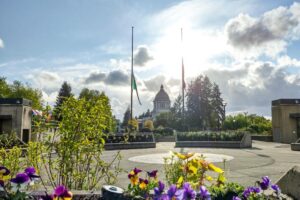
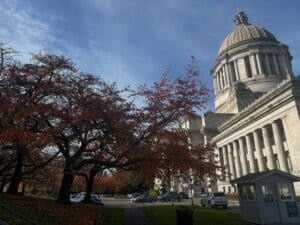
View of the Legislative Building from the Pollinator Garden
(Photo Courtesy: Washington Department of Enterprise Services)
The seven kinds of pollinators that visit our Capitol Campus, and are the main patrons of the Pollinator Garden, include butterflies, honey and bumble bees, hummingbirds, moths, beetles, flies, and more. Pollinators play a vital role in our ecosystem, transferring pollen between flowers, which then produce fertile seeds, which become food for people and wildlife. As we all look forward to the blossoming of the Sine Die Tree, we have these diligent critters to thank for the upcoming Spring blooms!

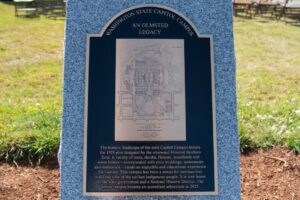
Sign on campus snapped while on the move during an early morning walk!
(Photo Courtesy: Erica Hallock)
Pollinators face threats to their existence and survival through habitat loss and degradation, pesticide use, invasive species, and climate change. Gardens and green spaces help preserve pollinator habitats and provide much needed food, water, shelter, and protection for these hard-working Washington residents! The Pollinator Garden is a prime example of an intentional space created to sustain pollinator species while beautifying our Capitol Campus.
Sources
Sources Capitol Pollinator Garden – Woodland Park Zoo
Pollinator Garden – Washington Department of Enterprise Services
Pollinator Friendly Parks – Xerces Society for Invertebrate Conservation