Skip to content

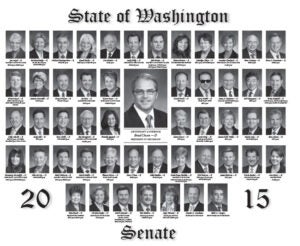
Headshots of the 2015 Washington State Senate, presented as a Class photo format

Hopping on the 2016 photos trend…

(Photo Credit: Washington State Legislature)

I will admit I do not understand the social media trend where people are posting pictures from 2016, but I’m hopping on that bandwagon for this week’s newsletter. I know this picture above is from 2015, but for this exercise – that doesn’t mean anything – let’s pretend it’s from 2016.

Of the 49 State Senators that were in the Senate in 2015, only nine remain in the State Senate today. Clearly a lot can change in ten years. (Which may be the point of the trend?)

For a little “Where are They Now?” – two of the former State Senators are now in the U.S. House of Representatives (with an additional former State Senator serving as a staff member to one of his former State Senate colleagues); several are serving in elected office at the local government level and one former State Senator is even a Jesuit Priest!

And, breaking this week, veteran State Senator Steve Conway who has served in the Legislature for 34 years, announced he will not seek reelection. So that number of remaining active State Senators from 2015/2016 will continue to drop.

Trivia!

Public tours of the Legislative building used to include a trip up to the top of the state Capitol dome. In what year did access to the top of the dome cease?

Highlights of the Week

Week 2 kicked off with ceremonies honoring Dr. Martin Luther King, Jr. The Washington State Legislature’s schedule is non-stop, in that it counts each day in its 60 or 105-day sessions. This includes weekends and holidays. Although Monday, January 19 was a national holiday, the Legislature was in session with a full day of floor activity and committee meetings.

Both the State Senate and House of Representatives held floor ceremonies honoring Dr. Martin Luther King, Jr., with the Senate and House both passing resolutions honoring the life and legacy of Dr. King, respectively, SR 8661 and HR 4672. Legislators in both chambers shared poignant and personal remarks about how Dr. King’s life and work guided their sense of service.

Because Monday was a national holiday, the campus was busier than usual with several organizational “lobby days” as constituents made their way to Olympia to share their priorities with lawmakers. A personal favorite was seeing all of the cute kids who were out of school and on campus for the day, including some children of staff members who may have looked a tad bored during committee hearings. (I feel ya, kids).

Busy Week of Committee Hearings

“Life Moves Pretty Fast…”. Ferris Bueller (1986). Life does move pretty fast and short session moves REALLY fast. With the February 4 policy committee cutoff quickly approaching and the February 9 fiscal cutoff shortly thereafter, policy committees are steadily working their way through bills.

I will note that given the state’s fiscal situation, many committee chairs are not scheduling hearings on bills that have fiscal impacts, recognizing those bills likely do not have a path to passage. I’ve noted the policy committee workload feels lighter. Now, the policy committee staff may not agree with that assessment!

Companion Bills Setting Up Account to Receive Ballmer Group Gift for ECEAP Heard in Fiscal Committees. This week, the Senate Ways and Means Committee held a hearing on SB 5872 (Wilson, C.) and the House Appropriations Committee heard its companion, HB 2159 (Bergquist). These bills are needed to establish the new account so the state can accept the Ballmer Group gift for ECEAP funding.

Both hearings included testimony from DCYF Secretary Tana Senn, Governor Bob Ferguson’s Policy Advisor Mary Sprute Garlant, Andi Smith, Executive Director of Washington and Behavioral Health from the Ballmer Group, and representatives of ECEAP.

The House Appropriations Committee has scheduled an executive session (vote) on the House bill for January 29, and the Senate Ways and Means Committee has not yet scheduled a vote.

House Early Learning and Human Services Committee Holds Children and Youth Behavioral Health Work Group Work Session/Hearing on Washington Thriving Legislation. On Tuesday, January 20, the House Early Learning and Human Services Committee held a work session to learn about recommendations of the Children and Youth Behavioral Health Workgroup and the next iteration of the work, Washington Thriving.

Representative Lisa Callan has introduced HB 2429 which would extend the Children and Youth Behavioral Health Workgroup’s lifecycle by two years and set the stage for implementation of the Washington Thriving strategic plan. Representative Callan’s HB 2429 was heard in the committee following the work session and has been scheduled for executive session (vote) on January 30.

The Senate companion bill, SB 6224 (Wilson, C.), has not yet been scheduled for a hearing.

What’s on Deck for Next Week?

Speaking of session moving fast, we are all anxiously awaiting the next revenue forecast on February 16. Month to month, revenue has been slightly trending up. This February 16 revenue forecast will inform the Supplemental Budget that lawmakers will vote on prior to adjourning Sine Die.

The following are bills on the schedule for next week. I fully expect this to change on the daily. If you are interested in a particular piece of legislation, I would urge you to monitor the legislative website as schedules are subject to change.

Following are some of the bills scheduled for hearing or executive session as of this writing:

  • HB 2438 (Bergquist) Establishing the Supporting Our Early Education Degree Seekers scholarship. This bill seeks to use a portion of the surplus from the Washington advanced college tuition payment program account (commonly known as Guaranteed Education Tuition – GET) to provide financial aid to students enrolled in eligible early childhood education programs. This bill is scheduled for a hearing in the House Committee on Postsecondary Education & Workforce on January 27.

  • SB 6206 (Dhingra) Establishing a pilot program that incentivizes child care providers to care for children of first responders. This bill would, subject to funds appropriated, provide funds to at least four local jurisdictions to provide incentive payments to licensed or certified child care providers who care for children of first responders. Incentive payments must be prioritized for licensed or certified child care providers that offer child care during nonstandard work hours, on short notice, and when a child has an illness.

    It will be heard in the Senate Early Learning and K-12 Education Committee on January 29.

  • HB 2529 (Dent) Concerning the Department of Children, Youth, and Families Accountability Board. This bill renames the DCYF Oversight Board to the DCYF Accountability Board and adjusts responsibilities. Its companion, SB 5942 (Wilson, C.), is scheduled for executive session (vote) in the Senate Human Services Committee on January 27.

    HB 2529 will be heard in the House Early Learning and Human Services Committee on January 27.

Bills, Bills, Bills

Bills continue to be introduced, albeit at a slower rate – we are already 1/5 of the way through session, but who is counting.

Here are some bills that were introduced this week that caught my eye:

  • HB 2594 (Reeves) Ensuring that unhoused children and youths in Washington have equal access to free, appropriate public education. This bill directs the Office of the Superintendent of Public Instruction to ensure that each child of a homeless individual and each homeless youth has equal access to the same free, appropriate public education, including a public preschool education for qualifying children, as provided to other children and youths. The bill includes language about efforts to ensure students remain in their “school of origin,” including preschool.

    The bill has a hearing in the House Education Committee on January 27.

  • SB 6215 (Hansen) Concerning fraud prevention. This bill would direct the Washington state auditor to develop a program like the United States Government Accountability Office’s “high-risk” list and to report to the Legislature annually on risk across state agencies, focusing on identifying program characteristics associated with elevated risk, assessing the effectiveness of existing internal controls, and recommending improvements that support ongoing risk mitigation.

    This bill is scheduled for a hearing in the Senate State Government, Tribal Affairs & Elections Committee on January 30.

  • SB 6179 (Dozier) Aligning child care subsidy base rates in Franklin County with Benton and Walla Walla counties. This bill would align child care subsidy base rates for licensed or certified child care providers in Franklin County with those in Benton and Walla Walla counties.

    It has not yet been scheduled for a hearing.

  • HB 2607 (Connors) Concerning child care rate regions. This bill would direct DCYF to review and rebase the child care rate regions to include regional adjustments in the child care subsidy base rates to reflect the actual cost of living and economic differences between regions. DCYF is encouraged to designate regions on a more localized basis than on the county level. The bill further provides that no provider may receive a lower child care subsidy base rate as compared to its prior year as a result of adjustments that reflect updated child care rate regions.

    It has not yet been scheduled for a hearing.

  • SB 6245 (Wilson, C.) Establishing a pilot program to advance funds to nonprofits to support grant performance. This bill would develop an “advance funds” pilot project for nonprofits that contract with the state for specific programs.

    It has not yet been scheduled for a hearing.

And under my new category of “that’s an interesting bill title to me personally but I don’t have time to learn more…”

  • SB 6272 (Liias, Pedersen) Concerning the design and operation of buildings to protect birds.

    My theory on this one is the design of certain buildings leads to birds inadvertently flying into them and meeting their end?

As a reminder, each Thursday, Start Early Washington updates its bill tracker with the latest information on bills we are following. If we have missed any bills of interest, please reach out and flag them for us!

Trivia Answers

In May 2007, the Washington State Department of Enterprise Services passed rules limiting access to the Capitol dome. Since then, only top agency officials and the Washington State Patrol have been permitted to ascend to the top of the dome.
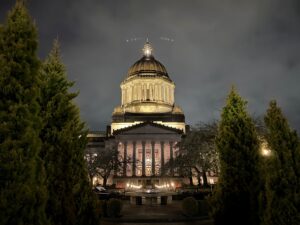
The south-facing entrance of the WA State Legislative Building at night during the 2nd week of the 2026 WA State Legislative Session.

(Photo Courtesy: Erica Hallock)

At 287 feet, the legislative building is the tallest masonry dome in the United States and among the tallest in the world.

However, a new provision passed in the 2025-27 biennial capital budget will allow up to 10 legislators a year to visit the top of the dome, guided by the DES director. Legislators have sparsely been able to visit the top of the dome, if at all, this century. Limitations on accessing the dome were first put into place in 1996, and following the Nisqually earthquake in 2001, repairs had to be made which extended into 2004 with further restrictions on access. With the dome itself weighing 30.8 million pounds, it’s reasonably imperative to ensure that visitors remain safe in trekking upward to the highest point of the building.

The steep, narrow spiral staircase from the 4th floor to the top of the dome is the source of health and safety concerns that prompted restrictions on access. A total of 266 metal steps to the top; the route poses challenges to climb, navigate, and in the case of emergency, to evacuate.

If you’re still curious about what the inside of our state’s capitol dome looks like, check out this video documenting the climb to the top.
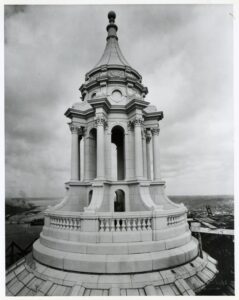
Up close shot of the Legislative Building in Olympia, Washington, shot includes the top of building with dome and lantern.

The Cupola and lantern atop the dome of the Legislative Building by Joseph William McKnight, 1926

(Photo Courtesy: Washington State Archives)

At over 250 feet high, the view of Olympia from the Cupola seems to be quite a sight. If given the opportunity, would you make the climb?

The answer for me is easy – yes. But I would need time to catch my breath! If you have “made it to the top” and have pictures, we would love to see them.

Sources

The Seattle Times

Washington State Standard

Washington State Department of Enterprise Services

More Like This

Contact Us

Connect with our team to learn more about our work or discuss how we can support policy and advocacy work for your organization.

Email Us

Washington State icon

Washington State Hub

Learn more about our work in Washington state and access relevant resources and publications. 

View Hub

Let's talk icon

Stay Connected

Stay up to date on the latest early childhood policy updates from Olympia.

Sign Up

The south-facing entrance of the WA State Legislative Building during the beginning of the 2026 WA State Legislative Session.

Photo Credit: Erica Hallock

Trivia!

Your family wasn’t the only one to take a vacation last summer. Our own State Constitution took its very first vacay away from Olympia! Which city did it visit? (I hope it packed sunscreen!)

Highlights of the Week

The start of session is often described as back-to-school season, but there is no equivalent of “syllabus week” in the Washington State Legislature as work got off to an explosive start. It was not uncommon to hear legislators, staff and lobbyists bemoaning that day 3 felt like day 303. A positive way to look at the level of activity is that there was no delay in addressing the needs of the people of Washington state.

Legislative Media Availability

There were several press availabilities for the Governor and legislative leadership to share their priorities and answer questions from the press about what’s “on top” for the 2026 legislative session.

I tried to catch most of these availabilities and was once again struck by the decline in the number of traditional press corps covering the Capitol. When I interviewed longtime Spokesman Review reporter Jim Camden back in 2024, he reflected on how he used to have to yell over the multitude of other reporters in gubernatorial press conferences to be heard, but today there are simply fewer reporters based in Olympia. Today, there are podcasters and bloggers in these media availabilities with distinct points of view, often asking more questions than the “traditional” press.

The media availability kicked off Friday before the start of the legislative session with the Washington Association of Broadcasters/Allied Daily Newspapers Legislative Briefing. This event consisted of three bi-partisan panels with Democratic and Republican Legislative Leadership, Operating Budget Leadership, and Transportation Budget Leadership. The event concluded with Governor Ferguson.

Governor Ferguson used his time to unveil his “Governor’s request” legislation for the upcoming year. This year, he is backing six pieces of legislation, including the “Pre-K Promise Act” made possible by a gift from the Ballmer Group to expand access to the state’s Early Childhood Education and Assistance Program (ECEAP).

Unfounded and racist accusations of fraud in our state’s Working Connections Child Care system that first arose online in late December were also raised during the Friday media availability. The issue also drew significant attention in the Tuesday, January 13 Legislative Democratic Leadership Media Availability and Legislative Republican Leadership Media Availability.

Democrats reinforced the accountability measures for child care provider reimbursements – including independent audits – while Republicans called for further review to ensure fraud is not prevalent in the system. In the Democratic Leadership Media Availability, legislators expressed concern over individuals conducting independent investigation and implored that any allegations should be directed toward the Department of Children, Youth and Families (DCYF).

State of the State

On Tuesday, Governor Bob Ferguson delivered his second State of the State address. Against a background of another challenging budget situation, Governor Ferguson aimed to strike a unifying tone. He reflected on how Washingtonians pulled together during the recent storms and flooding as an example of how we can “do hard things” and as a call for us to come together for the metaphorical storms that continue to come our way.

A definite choice, he did not specifically mention the state’s $2.3 billion budget gap and the significant budget cuts he suggested in his first proposed budget. He instead focused on creative bills lawmakers introduced, including bi-partisan bills and those with minimal fiscal impacts. He, of course, highlighted the Ballmer Group’s ECEAP gift.

Read the Washington Standard’s recap of his speech. (And as a mom of former teenagers, I totally caught his 17-year-old twins side eyes while he was calling them out. Hey, you got a day off from school!)

Budget Work Begins

Speaking of the budget, balancing this Supplemental Budget is THE focus during this 60-day session. Each of the fiscal committees heard this week from the Office of Financial Management Director KD Chapman-See about the details of Governor Ferguson’s proposed budgets followed by hours of public testimony in response.

It was sobering hearing the multitude of impactful – and important – programs under consideration for reduction or even elimination. In her own remarks, in media availabilities and in comments from the Rostrum on opening day, House Speaker Laurie Jinkins placed the origin for our state’s fiscal predicament at the feet of the federal government. The Speaker pointed to tariff impacts as well as implementation of HR 1, especially implementation costs related to Medicaid and SNAP, as particularly impactful.

Work Session

In response to media attention on purported (and unproven) allegations of fraud within our Working Connections Child Care system, the Senate Early Learning and K-12 Committee held a work session on January 15 focused on the state’s child care and accountability system.

Presenters included DCYF Assistant Secretary of Early Learning Nicole Rose, DCYF Assistant Secretary of Licensing Ruben Reeves, Child Care Aware’s Contract Lobbyist Jennifer Ziegler and Ella Fultz, owner and founder of Gathering Tree Early Learning in Vancouver, an in-home outdoor preschool.

Prior to hearing from panelists, Chair Wellman and Vice Chair Wilson provided opening remarks. Chair Wellman focused on existing accountability measures in place, highlighting this 2025 DCYF Overpayment Report. Senator Wilson spoke to the state’s quality system and its evolution. Senator Wilson stressed that our state has strong systems in place and that no one wants to see fraud.

You can view DCYF’s slide deck here and the Child Care Aware (CCA) slide deck here.

In short, the work session provided an opportunity for DCYF and CCA to speak with legislative committee members about their respective roles in the licensing, coaching, monitoring and accountability aspects of the subsidized child care system. Questions from committee members helped underscore the complexity of the system and the various safeguards in place to ensure program and fiscal integrity.

You can rewatch the work session on TVW here.

What’s on Deck for Next Week

Advocates are keenly aware that the first legislative cutoff is coming quickly (too quickly!) with policy committee cutoff approaching on February 4. This means if your bill did not get a hearing next week, its path is more complicated.

Here is what I am watching next week as it relates to early learning:

  • Pre-K Promise Bills Scheduled for Hearing in Fiscal Committees. SB 5872 (Wilson, C.) will be heard in the Senate Ways and Means Committee on Monday, January 19 and HB 2159 (Bergquist) will be heard in the House Appropriations Committee on Wednesday, January 21. These companion bills would set-up the Pre-K Promise Accounts, establishing the mechanism for the State to accept the Ballmer Group’s gift for ECEAP expansion.
  • House Capital Budget Committee Work Session on Grant Projects. On Thursday, January 22, the House Capital Budget Committee will hold a work session looking at the Department of Commerce’s Capital Budget Grants.
  • Bill to Expand ECEAP Eligibility Gets Senate Policy Committee Hearing. SB 5907 (Nobles), which would expand ECEAP eligibility to include populations of families in the military, will be heard in the Senate Early Learning and K-12 Committee on Tuesday, January 20. Its companion bill, HB 2099 (Leavitt) is scheduled for Executive Session (vote) in the House Early Learning and Human Services Committee on Friday, January 23.
  • Children and Youth Behavioral Health Gets Focus in House Early Learning and Human Services Committee. The House Early Learning and Human Services Committee will hold a work session focused on hearing recommendations from the Children and Youth Behavioral Health Workgroup followed by a public hearing on HB 2429 (Callan). HB 2429 looks to codify a number of recommendations from the Washington Thriving work, including establishing a Behavioral Health Leadership Council consisting of state agencies and using the Washington Thriving Strategic Plan to guide future work.

Bills, Bills, Bills

Bills continue to be introduced at a steady clip. Here are a few we wanted to call to your attention:

  • HB 2438 (Bergquist), Establishing the supporting our early education degree seekers scholarship. This bill seeks to direct a portion of the surplus from the state’s college tuition payment program (Guaranteed Education Tuition – GET) to provide financial aid to students enrolled in eligible early childhood education programs.
  • SB 6078 (Slatter), Providing prelicensing supports to individuals interested in becoming a licensed child care provider. This bill addresses prelicensing supports for child care providers, codifying services related to prelicensing supports (e.g. navigating the facilities development process). It provides that DCYF may, within existing resources, develop and publicize an online child care license resource guide for individuals interested in obtaining a child care license when they submit a permit application to a city or a county. It also requires cities or counties to notify applicants for child care licenses of the availability of DCYF prelicensing supports. This bill is scheduled for hearing in the Senate Early Learning and K-12 Committee on January 22.

And my personal favorite (or the one in my nightmares)…

  • SB 6108 (Frame) / HB 2447 (Reeves), Designating the State Shark. Why – oh why – do we need this?

As a reminder, each Thursday, Start Early Washington updates its bill tracker with the latest information on bills we are following. Note that we have only included bills from the second half of the biennium in this week’s tracker. Other bills from earlier in the biennium could still be addressed this session. If we have missed any bills of interest, please reach out and flag them for us!

Start Early Washington Resources

With many changes – some good and some not so good – to Washington’s mixed-delivery early learning system over the last year, we thought it might be helpful to provide a “state of play”, which you can find on our Policy Resources page. This document offers a moment-in-time snapshot of Working Connections Child Care (WCCC), Early Childhood Education and Assistance Program (ECEAP), and Transition to Kindergarten (TTK) in our state. Key policy and budget changes from the 2025 session that impact planned expansions are also synthesized in this document.

Trivia Answer

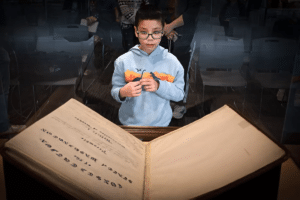
In honor of Constitution Week, the State Constitution visited Spokane on September 15, 2025. This is the first time the document has traveled to Eastern Washington.

Since adoption in 1889, the State Constitution has been housed in Olympia, where for most of its history, lived on a shelf in the basement of the old Capitol building. However, today it is kept in a climate-controlled vault and is not usually available for public viewing. But last September, the document traveled across the state with state Archivists, an escort by the State Patrol, and was displayed in the Spokane Central Library under UV-shielding glass.

Oliver Hokama viewing the original Washington state Constitution on display at the Spokane Public Library.

Oliver Hokama, 8, views the original Washington state Constitution on display at the Spokane Central Library.

(Photo Courtesy: Colin Mulvany, The Spokesman-Review)

This vacation was part of an overall effort of the State Archivists and the Secretary of State, Steve Hobbs, plan to bring more of Washington’s historical documents out of the archive in Olympia for the public to engage with. You can read about the experiences of State Constitution viewers in Spokane in this Spokesman-Review article.

As a Spokanite, I think this is super cool, but I do think there was a bit of a missed opportunity. I personally would have liked to see pictures of the State Constitution riding the famous Looff Carrousel at Spokane’s Riverfront Park or viewing the roaring Spokane Falls (the glass covering protecting the document from any damage). I am, though, relieved it did not visit the Park’s Garbage Goat, because that Goat is known to chow down on paper!

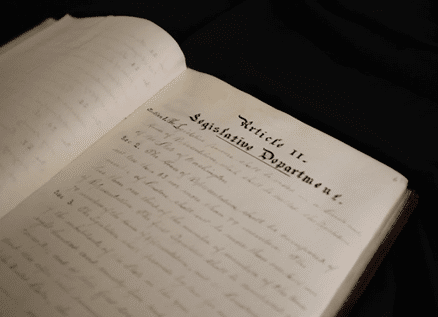
WA State Constitution open on the Article II page

(Photo Courtesy: Washington Secretary of State)

The State Constitution was drafted by 75 male delegates in 1889, and on November 11, 1889, President Benjamin Harrison approved the Constitution, making Washington the 42nd state of the United States of America. You can read the State Constitution in full here.

The Washington State Constitution was modeled after Oregon’s State Constitution and adapted some language from California’s as well. Our state’s constitution is laid out on 78 handwritten, leatherbound pages. Today the Constitution comprises just under 33,000 words making up 32 articles and over 100 amendments. When put to a vote for ratification, 40,152 supported ratification and 11,879 opposed.

Nowadays, Washington state has over 5,101,680 registered voters. Just this past fall, 1,733,636 of Washington’s voters voted on amending our state’s constitution once more.

Kicking off the 2026 legislative session, the State Constitution was temporarily displayed in the Governor’s office and available for public viewing on Monday, January 12. State Archivists were on hand to answer questions about the document, and Washington State Patrol escorted and guarded the document as they did on its “vacation” earlier this year. The Governor remarked to the House delegation that this was his first time viewing the State Constitution in person.

Sources

Secretary of State News – State Constitution To Be Displayed in Eastern Washington for First Time

Secretary of State News – The Original State Constitution to be Displayed in the Governor’s Office Next Week

Secretary of State Ballot Return Statistics

The Spokesman-Review

The University of Washington School of Law

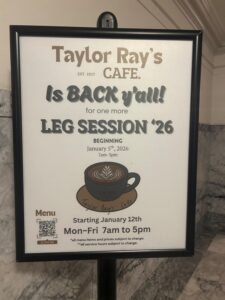
Taylor Ray's Cafe sign announcing they are back for the 2026 WA Legislative Session

Best News Ever! Taylor Ray’s is back operating the cafeteria in the Dome Deli. IYKYK

More Like This

Contact Us

Connect with our team to learn more about our work or discuss how we can support policy and advocacy work for your organization.

Email Us

Washington State icon

Washington State Hub

Learn more about our work in Washington state and access relevant resources and publications. 

View Hub

Let's talk icon

Stay Connected

Stay up to date on the latest early childhood policy updates from Olympia.

Sign Up

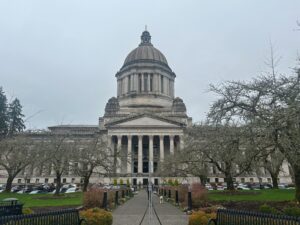
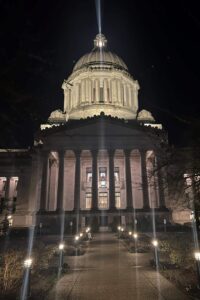
An image of the front of the Capitol with path illuminated at night

“The calm before the storm”

The Legislative Building Awaits the 2026 Session

(Photo Courtesy: Erica Hallock)

Trivia!

“By the Numbers – the 2026 Legislative Session”

  • 60   Number of days of this “short” session
  • 353   Number of bills “Pre-filed” before the Jan. 12th start of the 2026 legislative session
  • 2   Number of times the word “ungulate” appears in bill titles of pre-filed bills (per AI, ungulate means hoofed mammal)
  • 2303HB 2303 – Title of the bill I found most intriguing “Prohibiting employers from microchipping employees” (I have so many questions!)
  • 2.3   Amount – in billions of dollars – of the state’s budget deficit for the remainder of the 2025-27 biennium
  • 1   Amount – again, in billions of dollars – of funding Governor Ferguson proposes to transfer from the Budget Stabilization Account to help address the budget gap
  • 797   Amount – this time, in millions of dollars – of funding Governor Ferguson proposed in spending reductions in his budget proposal
  • 0   Number of “Member Requests” for spending Sen. Ways and Means Chair June Robinson says she will accept from Senators given the budget crisis

What’s on Deck for Next Week

The 2026 legislative session officially kicks off at noon on Monday, Jan. 12th with “Opening Day.” Sorry, baseball fans, it’s not quite THAT opening day.

Little time is built in to catch up on interim activities as committee meetings kick off that same afternoon with the Senate Ways and Means and House Appropriations Committees holding public hearings on Governor Ferguson’s Supplemental Budget proposals right out of the gate. The Senate Ways and Means Committee will convene at 4:00 p.m. on Monday, Jan. 12th for public feedback on the Governor’s proposed Capital Budget (you can register here to provide oral or written testimony) and the House Appropriations Committee will also meet at 4:00 p.m. on Monday (with follow up scheduled for Wednesday at 4:00 p.m. if they go into overtime). The House Appropriations Committee will focus on the Operating Budget and you can register here to provide oral or written testimony.

Tuesday, the Senate and House of Representatives will gather in the House Chamber for a Joint Session to hear Governor Ferguson present his annual State of the State address at noon. You can catch the address live on TVW.org or later on TVW’s media archives.

Finally, on Thursday, Jan. 15th, the Senate Early Learning and K-12 Committee will hold a work session at 10:30 a.m. entitled “Washington’s child care monitoring and accountability systems.” Work sessions differ from public hearings in that presenters must be invited, and members of the public are not able to provide testimony or comments. We will cover this work session in next week’s Notes From Olympia.

Bills, Bills, Bills

With a short, 60-day session, the process moves quickly. So, it is no surprise that the schedule for week one is filled with bill hearings. Well over 300 bills were pre-filed before the start of the legislative session. Advocates are well aware that the first legislative cutoff is fast approaching on Feb. 4th.

As of this writing, there are a limited number of hearings scheduled on early learning bills for week one, but that does not mean early learning will not be a topic of conversation.

  • HB 2219 (Ortiz-Self), Enhancing the Operational Efficiency of Child Care Providers. Scheduled for a hearing in the House Early Learning and Human Services Committee on Wednesday, Jan. 14th, this bill would require DCYF to waive the early learning program preservice requirement to complete a department-provided orientation for any individual who has previously completed the applicable orientation. It would also adjust maximum group size and staff-to-child ratios for child care centers to account for staff meal- and rest-breaks.

Friday, Jan. 16th is early learning day in the House Early Learning and Human Services Committee with the following bills scheduled for public hearing:

  • HB 2099 (Leavitt), Expanding Access to ECEAP for Military Families. This bill would amend ECEAP eligibility requirements to allow children from military families with incomes above 36 percent of the State Median Income, but at or below the household income for Working Connections Child Care eligibility, to be eligible for ECEAP. Its companion is SB 5907 (Nobles) which has not yet been scheduled for a public hearing.
  • HB 2317 (Eslick), Concerning Early Learning Licensing Program Requirements. This bill amends current state licensing statute to add to the definition of “agency” a part-day or school-day ECEAP program or Head Start program that is located in a public school building or on public school property.
  • HB 2318 (Eslick), Adjusting the Early Achievers Quality Improvement Awards. This bill would change the qualifications for Early Achievers Quality Improvement Awards to specify that the awards would apply to programs with populations consisting of a total of at least five percent of enrolled children who are receiving a state subsidy, participating in the early childhood education and assistance program, or participating in the head start program. (Proposed additions are underscored).

Following is a summary of a couple of the other bills we will be watching and engaging with this session. As a reminder, each Thursday, Start Early Washington updates its bill tracker with the latest information on bills we are following. Note that we have only included pre-filed bills in this week’s tracker. Other bills from the biennium could still be addressed this session. If we have missed any bills of interest, please reach out and flag them for us!

  • HB 2159 (Bergquist)/SB 5872 (Wilson, C.), Establishing the PreK Promise Account. Companion bills (meaning they are identical), these bills establish the account for the state to accept the gift from Ballmer Group to support expansions to the Early Childhood Education and Assistance Program (ECEAP).
  • HB 2282 (Bernbaum), Supporting the Implementation of Transition to Kindergarten Programs. This bill would direct the Office of the Superintendent of Public Instruction (OSPI) to prioritize Transition to Kindergarten funding for programs that did not operate in either the 2024-25 or 2025-26 school years but submitted a notice to implement and administer a program to OSPI prior to June 1, 2025.

Tips for Visiting the Capitol Campus this Legislative Session

Navigating the Capitol Campus can be challenging during the legislative session. The Department of Enterprise Services released a handy-dandy tip sheet with information on everything from parking options to food options (which are limited) to even lactation rooms. If you are making your way to Olympia this year, bookmark this link!

A graphic of hand dropping a letter in suggestion box

Suggestions welcomed! Have an idea for an item you would like to see covered in an upcoming “Notes From Olympia?” Confused about an aspect of the legislative process? (You likely aren’t the only one!) Privy to a piece of history that would make for a juicy “trivia” topic? Send them our way!

More Like This

Contact Us

Connect with our team to learn more about our work or discuss how we can support policy and advocacy work for your organization.

Email Us

Washington State icon

Washington State Hub

Learn more about our work in Washington state and access relevant resources and publications. 

View Hub

Let's talk icon

Stay Connected

Stay up to date on the latest early childhood policy updates from Olympia.

Sign Up