For Holly Bamford Hunt, community isn’t an abstract idea, it’s a relationship. And relationships, she believes, begin with listening.
Raised in Tacoma, Holly grew up in a family where showing up for the community was simply part of daily life. Around the dinner table, values like service, education, and care for others weren’t debated, they were practiced. Her mother, a former teacher, volunteered extensively with organizations serving children and families, including United Way of Pierce County and CASA as a Court Appointed Special Advocate, supporting children and families involved in child welfare. Her father also gave his time through the YMCA and community programs. From an early age, Holly and her siblings were invited into that work, collecting donations, babysitting, volunteering, and learning to pay attention to what people around them needed.
Stay Connected
Sign up to receive the latest early learning program and policy news in Washington state.
That early grounding continues to shape Holly’s leadership today as Executive Director of The Bamford Foundation, a place-based family foundation deeply rooted in Pierce County. What distinguishes her approach is not only her family’s legacy, but her belief that strong systems are built by listening first to families, caregivers, and community-based organizations.
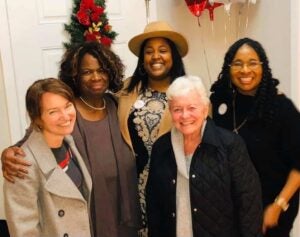
Holly Bamford Hunt & Joanne Bamford of The Bamford Foundation with the Raising Girls team.
Learning From Families, Teachers, and Systems
Holly’s commitment to early childhood is deeply personal and professional. Her career began in the classroom as a preschool teacher in Chicago, working in a full-day pre-K model that brought together children from different cultures, languages, and income levels. “Preschoolers don’t make judgments,” she reflects. “They learn alongside each other and so do we.”
That experience, combined with work in early intervention, grant writing, and research, helped Holly understand how early learning systems function, or fail, depending on how closely they respond to the realities families face. When she returned to Washington, she taught special education in South Kitsap and later supported parent–infant-toddler classes, continuing to listen and learn from caregivers navigating complex systems.
Just as important were the informal spaces, county convenings, early learning networks, and collaborative tables where organizations shared what was working and where families were falling through the cracks. “It’s been a real lesson,” Holly says, “in how critical the connective tissue is among organizations when you’re trying to center children and families and make sure they have what they need.”
The most important thing philanthropy can do is listen to communities and let families and providers tell us what they need to thrive.
Holly Bamford Hunt, Executive Director, Bamford Foundation
Philanthropy as Partnership, Not Prescription
The Bamford Family Foundation was established in 1990 by Holly’s parents, following the success of a multigenerational family business. In its early years, grantmaking closely reflected her parents’ volunteer commitments and personal relationships across Pierce County.
As the Foundation evolved, the family came together to ask deeper questions: What do we care about most? And how do we ensure our giving reflects what the community is actually asking for?
Holly Bamford Hunt & Joanne Bamford supporting the Raising Girls work with their care bags.
Through that process, clear priorities emerged: access to basic needs, education across the lifespan, early childhood and caregiver support, out-of-school time, and postsecondary pathways. Underlying all of them was a shared understanding: families cannot access education or opportunity without housing, food security, health, and a sense of belonging.For Holly, stewardship of the Foundation means resisting the urge to prescribe solutions. “Many funders are looking at the landscape and saying, ‘Where are the gaps?’” she explains. “But you can’t answer that without listening to the organizations and families who live with those gaps every day.”
That belief has led the Foundation to emphasize trust-based philanthropy and prioritizing general operating support, long-term relationships, and opportunities for organizations to learn from one another. “Community organizations know what their families need,” Holly says. “Our role is to support their ability to respond.”
Supporting healthy, thriving families starts by asking what support actually looks like in each community and believing the answers.
Holly Bamford Hunt, Executive Director, Bamford Foundation
When Listening Turns Into Systems Change
Some of the clearest examples of community listening turning into systems change emerged during the pandemic. In Pierce County, nonprofits, school districts, parks, healthcare providers, and philanthropy came together quickly to respond to urgent needs, especially childcare for essential workers.
What stood out to Holly wasn’t just the speed of the response, but how deeply it was informed by community voices. Families, providers, and grassroots organizations identified what was missing -childcare access, diapers, safe spaces for children, and systems adapted. Emergency solutions evolved into lasting infrastructure, including expanded diaper banks and collaborative afterschool models that continue to serve families today.
“These networks didn’t just disappear,” Holly notes. “They stayed because they were built around real needs that people named themselves.”
She sees the same principle at work in rural and unincorporated parts of Pierce County, where childcare access often hinges on transportation, permitting, or facilities. Progress happens, she says, when philanthropy and systems partners take the time to understand local realities and trust communities to lead.
A Future Defined by Belonging
Looking ahead, Holly is excited about the Foundation’s continued evolution, including recent steps to eventually include community members on its board. For a geographically focused foundation, she sees this as a natural extension of listening, bringing community voices into governance, not just grantmaking.
When asked what she wishes for every baby born in 2026, her answer reflects the heart of her work:
“I want every child and the caregivers who surround them to feel completely supported to be the families they want to be,” she says. “That starts with belonging and with listening to what support actually looks like in each community.”
Bamford family in front of an outdoor lights display.
For Holly, thriving families are the result of systems that pay attention, adapt, and invest with humility. It’s why she believes early childhood work must always be connected to policy, advocacy, and collaboration across sectors. She notes that the foundation is grateful for organizations like Start Early Washington, who offer programs and professional development, while also leading in policy and advocacy focused on strengthening the system.
As she puts it simply, “You can’t have a thriving community unless all children are thriving.”
And thriving, she reminds us, begins by listening.
Washington State Hub
Learn more about our work in Washington state and access relevant resources and publications.