
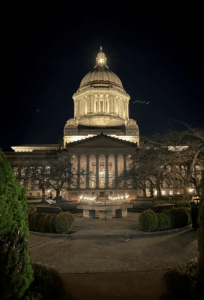
(Photo Credit: Erica Hallock)
Trivia!
Who has been the only person in our state’s history to lay in state in the State Reception Room in the Legislative Building?
Highlights of the Week
Cost of Care Legislation Passes Off Senate Floor
On January 28, the Senate adopted a striking amendment to ESSB 5500 (Alvarado) before passing the amended bill off the Senate Floor by a 30-19 vote. A striking amendment – or ‘striker’ – means the full text of the bill after the title is removed and replaced with new language.
The legislation now provides a definition of “cost of quality child care” based on previous work by the Early Educator Design Team and DCYF. Specifically, the bill includes living wage salaries; benefits; planning release time; and other program and staff supports as elements of “quality care” with measurable costs. DCYF is required to complete a cost of quality care survey in even-numbered years along with a Market Rate Survey study. The bill now moves to the House for consideration.
House Pre-K Promise Bill Was Scheduled for Vote in House Appropriations Thursday Night
By the time this newsletter hits your inbox, the House Appropriations Committee should have already voted on HB 2159 (Bergquist) which would establish the account to receive the Ballmer Group’s financial gift for expansion of the state’s Early Childhood Education Assistance Program (ECEAP).
According to an amendment posted on the legislative website proposed by the bill sponsor Representative Bergquist, the House Appropriations Committee was set to consider an amendment that would allow the Ballmer Group’s gift to support any child enrolled in ECEAP, rather than solely those eligible for ECEAP as the bill was originally written. The proposed amendment would allow the funds to serve a broader population.
House Postsecondary Education and Workforce Committee Considers Bill to Direct Surplus Funding from State’s GET Program to Early Childhood Workforce
On Tuesday, January 27, the House Postsecondary Education and Workforce Committee held a hearing on HB 2438 (Bergquist). This bill would establish the Supporting Our Early Education Degree Seekers (SEEDS) scholarship to provide up to 90 credits of tuition-free community or technical college for students enrolled in eligible early childhood education degrees or programs beginning in the 2027-28 academic year using surplus funds from the state’s Guaranteed Education Tuition (GET) program.
In his remarks, Representative Bergquist noted ongoing workforce challenges in child care and early learning – and the additional strain that ECEAP expansion will have on an already taxed industry.
The bill has been scheduled for an executive session (vote) on February 3.
What’s on Deck for Next Week?
It’s Cutoff Time…
The legislative process contains a number of deadlines meant to winnow down the number of bills under consideration. The first of these filters arrives next week on February 4 with the “House of Origin Policy Committee Cutoff.” This very formal sounding name means that bills must pass out of the policy committee from their originating body (House or Senate) to continue through the process this year.
With this first cutoff approaching, Week 4 will largely focus on executive sessions (votes) in policy committees. A small number of bills will see both public hearings and votes in the same week. Things can change on a dime, so it is important to stay on top of committee schedules and bill amendments, particularly during cutoff weeks.
Once this cutoff hits, there will be no rest for those involved in the legislative process as work will quickly pivot to the fiscal committee cutoff on February 9. Fiscal committees are scheduled for weekend work to meet the quick turnaround.
A couple of relevant bills that are scheduled for public hearing in House Appropriations on Monday, February 2:
HB 2607 (Connors) Concerning Child Care Regions. This bill would direct DCYF to make regional adjustments to child care subsidy base rates that reflect the actual cost of living and economic variations between regions. It would encourage DCYF to make regions localized beyond the county level. The bill further indicates that no provider may receive a lower child care subsidy base rate as compared to its prior year as a result of these adjustments.
The bill sponsor is from the Kennewick/Tri Cities area. There is a similarly themed bill (SB 6179 by Senator Dozier) that would align child care base subsidy rates in Franklin County with Benton and Walla Walla counties. SB 6179 was referred to the Senate Early Learning and K-12 Committee but has not been scheduled for a hearing prior to the policy committee cutoff.
HB 2587 (Cortes) Establishing a pilot program to advance funds to nonprofits to support grant performance. This bill would direct the Department of Commerce to establish the “advance funding pilot program” to advance funds to eligible grant recipients who have demonstrated the need for advance funding to perform the work required by the department grant.
Bills, Bills, Bills – and a Refresh of what “NTIB” Means
Office of Financial Management Request Legislation to Achieve Budget Savings Introduced:
HB 2688 (Gregerson) and HB 2689 (Gregerson) seek to make statutory changes needed to implement provisions of Governor Ferguson’s Supplemental Budget and achieve his proposed budget savings in early learning.
HB 2688 relates to the Early Support for Infants and Toddlers (ESIT) program. It would “decouple” the ESIT multiplier from the multiplier used for special education pre-K students. This would remove the escalating effect created through E2SSB 5263 (Pedersen) of 2025 which “hinged” the ESIT multiplier to the Pre-K special education multiplier.
HB 2689 relates to the Working Connections Child Care (WCCC) program. It makes a number of changes to the WCCC to achieve budget savings. These changes include:
- Pausing the acceptance of new applications to the WCCC program beginning July 1, 2026 through December 31, 2026. Families engaged in the child welfare system (this engagement is defined in statute) would be exempt from this pause.
- Establishing an average monthly caseload cap of 33,000 families (with child welfare involved families exempt from this cap) effective January 1, 2027. New applicants to WCCC could be accepted effective January 1, 2027 as long as the average monthly caseload does not exceed 33,000 as of that date.
- Establishing a prioritization list for admission to WCCC, ensuring monthly caseload remains no higher than 33,000 families (again, with exceptions for child welfare involved families):
- Families applying for or receiving Temporary Assistance for Needy Families (TANF);
- Families who are curing a sanction pursuant to TANF (meaning complying with efforts to bring a case back into compliance to restore full TANF benefits);
- Families that include a child with special needs;
- Families in which the parent is a minor in school full-time with school-sponsored on-site child care;
- Families that received subsidies in the last 30 days and: (a) Have reapplied for subsidies; and (b) have household income of 60 percent of the state median income or below; and
- All other families applying for WCCC.
- Modifying WCCC rate for child care centers effective July 1, 2026 to the 75th percentile of the most recent Market Rate Survey (for this year’s purpose, this was the survey conducted in 2024). The bill language also states that family child care will continue to be paid at the rate negotiated in the 2025-27 Collective Bargaining Agreement, but signals intention that both center and family child care rates will move to the 75th percentile of market rate following the next Market Rate Survey.
And in the new category of bills that caught my attention this week simply because of their title.
SB 6322 (Braun) “Directing the relocation of the Bob Oke game farm”
OK, I checked the Internet and there’s some drama down in Lewis County surrounding a state-run pheasant farm (the Bob Oke Game Farm) that is creating nitrate contamination in Centralia groundwater. Hence the bill to relocate said game farm. And now, I’m intrigued.
As a reminder, each Thursday, Start Early Washington updates its bill tracker with the latest information on bills we are following. If we have missed any bills of interest, please reach out and flag them for us!
What does “NTIB” mean?
Every profession has its share of acronyms, and the legislative world is no exception. NTIB stands for “Necessary to Implement the Budget,” and with various cutoff dates approaching, I wanted to refresh readers on what it means and its importance in the legislative lingo.
We talk about bills needing to pass through various milestones by “cutoff” dates to remain “alive.” As mentioned above, the first cutoff date of the 2026 session is the House of Origin Policy Committee Cutoff on February 4. This means that bills must be passed out of their originating body’s policy committee to be considered for further action.
That is unless a bill has been deemed “NTIB,” or Necessary to Implement the Budget. NTIB bills are not subject to any cutoff timelines. It is not unusual for NTIB bills to sail through the process quite quickly because they reflect agreement among legislative leadership on budget decisions.
Legislative leadership makes the determination of whether a bill is NTIB. The two bills introduced this week and explained above (HB 2688 and HB 2689) are prime examples of NTIB bills.
If you are interested in a primer on Washington’s budgeting process, TVW has a short 11-minute video for you. Thank you, TVW!
Trivia Answer!
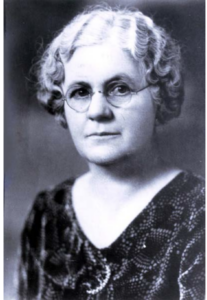
Washington State Secretary of State Belle Reeves
1870-1948
(Photo Courtesy: Washington State Legislature)
Secretary of State Belle Reeves is the only person – to date – to have ever lay in state in the State Reception Room in the State Legislative Building following her 1948 death.
Let’s learn about Secretary of State Belle Reeves, shall we?
Born in the state of Ohio, Reeves (1870-1948) originally studied to be a teacher. After marrying, she and her husband moved to Spokane where her husband worked as a reporter for the Spokesman Review.
Eventually landing in Wenatchee after a failed effort to “strike it rich” in the gold and silver mines around Coeur d’ Alene, ID, Reeves became very active in community work while her husband built his law practice. Without her knowledge, her fellow community members launched a write-in campaign for her to serve in the local House of Representatives seat and she won the primary by 100 votes. She went on to win the general election and served in the House of Representatives from 1923-1927 and from 1931-38. Of note, she chaired the “Public Morals Committee.” (What a different time…)
While in the House of Representatives, she sponsored legislation in 1925 to establish separate facilities for female prisoners. She also sponsored legislation that was ultimately vetoed by then Governor Roland Hartley that would have provided rehabilitative services for female prisoners.
In his veto message, Governor Hartley said female convicts were “diseased and beyond redemption.” Reeves used this setback as motivation to recruit more women into elected office.
Sadly, in 1933, while Reeves was on the House Floor fighting against the repeal of federal prohibition, her husband – who was in the back of the House Chamber supporting his wife – collapsed and was pronounced dead at the scene by a State Senator who was also a physician. Following her husband’s passing, Reeves continued on in elected office while also maintaining the couple’s 100-acre fruit orchard in Wenatchee.
In 1938, Governor Clarence Martin appointed Reeves as Washington’s first female Secretary of State following the sudden death of Secretary of State Ernest Hutchinson. At that time, Reeves was only the second woman to hold statewide office in Washington state and until Kim Wyman’s election to the same office in 2012, she was the only woman to hold that seat.
A few fun facts about Secretary of State Reeves’ time in this office. In her 1944 re-election campaign, Reeves received the most votes ever cast for a candidate in the state’s history. And as the third in line, Reeves occasionally served as acting Governor when the Governor and Lt. Governor were out of state. In that role, she dedicated a new road in Soap Lake and threw out the first pitch at the opening game of the Olympia Senators spring season (I could not find information on how the pitch landed).
Even as Reeves’ health declined, she refused to resign from office, famously saying she would remain in office “as long as I can wiggle one little finger.”
Reeves died in office at the age of 77 and her official funeral was held in the Legislative Building with the Governor, State Superintendent of Public Instruction and members of the State Supreme Court serving as honorary pall bearers.
Clearly, Secretary of State Reeves was a beloved figure.
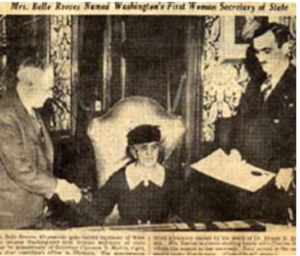
Press coverage of Secretary of State Reeves Named as first Female to Hold Seat
(Photo Courtesy: Washington State University)