Hopping on the 2016 photos trend…
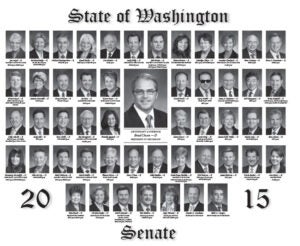
(Photo Credit: Washington State Legislature)
I will admit I do not understand the social media trend where people are posting pictures from 2016, but I’m hopping on that bandwagon for this week’s newsletter. I know this picture above is from 2015, but for this exercise – that doesn’t mean anything – let’s pretend it’s from 2016.
Of the 49 State Senators that were in the Senate in 2015, only nine remain in the State Senate today. Clearly a lot can change in ten years. (Which may be the point of the trend?)
For a little “Where are They Now?” – two of the former State Senators are now in the U.S. House of Representatives (with an additional former State Senator serving as a staff member to one of his former State Senate colleagues); several are serving in elected office at the local government level and one former State Senator is even a Jesuit Priest!
And, breaking this week, veteran State Senator Steve Conway who has served in the Legislature for 34 years, announced he will not seek reelection. So that number of remaining active State Senators from 2015/2016 will continue to drop.
Trivia!
Public tours of the Legislative building used to include a trip up to the top of the state Capitol dome. In what year did access to the top of the dome cease?
Highlights of the Week
Week 2 kicked off with ceremonies honoring Dr. Martin Luther King, Jr. The Washington State Legislature’s schedule is non-stop, in that it counts each day in its 60 or 105-day sessions. This includes weekends and holidays. Although Monday, January 19 was a national holiday, the Legislature was in session with a full day of floor activity and committee meetings.
Both the State Senate and House of Representatives held floor ceremonies honoring Dr. Martin Luther King, Jr., with the Senate and House both passing resolutions honoring the life and legacy of Dr. King, respectively, SR 8661 and HR 4672. Legislators in both chambers shared poignant and personal remarks about how Dr. King’s life and work guided their sense of service.
Because Monday was a national holiday, the campus was busier than usual with several organizational “lobby days” as constituents made their way to Olympia to share their priorities with lawmakers. A personal favorite was seeing all of the cute kids who were out of school and on campus for the day, including some children of staff members who may have looked a tad bored during committee hearings. (I feel ya, kids).
Busy Week of Committee Hearings
“Life Moves Pretty Fast…”. Ferris Bueller (1986). Life does move pretty fast and short session moves REALLY fast. With the February 4 policy committee cutoff quickly approaching and the February 9 fiscal cutoff shortly thereafter, policy committees are steadily working their way through bills.
I will note that given the state’s fiscal situation, many committee chairs are not scheduling hearings on bills that have fiscal impacts, recognizing those bills likely do not have a path to passage. I’ve noted the policy committee workload feels lighter. Now, the policy committee staff may not agree with that assessment!
Companion Bills Setting Up Account to Receive Ballmer Group Gift for ECEAP Heard in Fiscal Committees. This week, the Senate Ways and Means Committee held a hearing on SB 5872 (Wilson, C.) and the House Appropriations Committee heard its companion, HB 2159 (Bergquist). These bills are needed to establish the new account so the state can accept the Ballmer Group gift for ECEAP funding.
Both hearings included testimony from DCYF Secretary Tana Senn, Governor Bob Ferguson’s Policy Advisor Mary Sprute Garlant, Andi Smith, Executive Director of Washington and Behavioral Health from the Ballmer Group, and representatives of ECEAP.
The House Appropriations Committee has scheduled an executive session (vote) on the House bill for January 29, and the Senate Ways and Means Committee has not yet scheduled a vote.
House Early Learning and Human Services Committee Holds Children and Youth Behavioral Health Work Group Work Session/Hearing on Washington Thriving Legislation. On Tuesday, January 20, the House Early Learning and Human Services Committee held a work session to learn about recommendations of the Children and Youth Behavioral Health Workgroup and the next iteration of the work, Washington Thriving.
Representative Lisa Callan has introduced HB 2429 which would extend the Children and Youth Behavioral Health Workgroup’s lifecycle by two years and set the stage for implementation of the Washington Thriving strategic plan. Representative Callan’s HB 2429 was heard in the committee following the work session and has been scheduled for executive session (vote) on January 30.
The Senate companion bill, SB 6224 (Wilson, C.), has not yet been scheduled for a hearing.
What’s on Deck for Next Week?
Speaking of session moving fast, we are all anxiously awaiting the next revenue forecast on February 16. Month to month, revenue has been slightly trending up. This February 16 revenue forecast will inform the Supplemental Budget that lawmakers will vote on prior to adjourning Sine Die.
The following are bills on the schedule for next week. I fully expect this to change on the daily. If you are interested in a particular piece of legislation, I would urge you to monitor the legislative website as schedules are subject to change.
Following are some of the bills scheduled for hearing or executive session as of this writing:
-
HB 2438 (Bergquist) Establishing the Supporting Our Early Education Degree Seekers scholarship. This bill seeks to use a portion of the surplus from the Washington advanced college tuition payment program account (commonly known as Guaranteed Education Tuition – GET) to provide financial aid to students enrolled in eligible early childhood education programs. This bill is scheduled for a hearing in the House Committee on Postsecondary Education & Workforce on January 27.
-
SB 6206 (Dhingra) Establishing a pilot program that incentivizes child care providers to care for children of first responders. This bill would, subject to funds appropriated, provide funds to at least four local jurisdictions to provide incentive payments to licensed or certified child care providers who care for children of first responders. Incentive payments must be prioritized for licensed or certified child care providers that offer child care during nonstandard work hours, on short notice, and when a child has an illness.
It will be heard in the Senate Early Learning and K-12 Education Committee on January 29.
-
HB 2529 (Dent) Concerning the Department of Children, Youth, and Families Accountability Board. This bill renames the DCYF Oversight Board to the DCYF Accountability Board and adjusts responsibilities. Its companion, SB 5942 (Wilson, C.), is scheduled for executive session (vote) in the Senate Human Services Committee on January 27.
HB 2529 will be heard in the House Early Learning and Human Services Committee on January 27.
Bills, Bills, Bills
Bills continue to be introduced, albeit at a slower rate – we are already 1/5 of the way through session, but who is counting.
Here are some bills that were introduced this week that caught my eye:
-
HB 2594 (Reeves) Ensuring that unhoused children and youths in Washington have equal access to free, appropriate public education. This bill directs the Office of the Superintendent of Public Instruction to ensure that each child of a homeless individual and each homeless youth has equal access to the same free, appropriate public education, including a public preschool education for qualifying children, as provided to other children and youths. The bill includes language about efforts to ensure students remain in their “school of origin,” including preschool.
The bill has a hearing in the House Education Committee on January 27.
-
SB 6215 (Hansen) Concerning fraud prevention. This bill would direct the Washington state auditor to develop a program like the United States Government Accountability Office’s “high-risk” list and to report to the Legislature annually on risk across state agencies, focusing on identifying program characteristics associated with elevated risk, assessing the effectiveness of existing internal controls, and recommending improvements that support ongoing risk mitigation.
This bill is scheduled for a hearing in the Senate State Government, Tribal Affairs & Elections Committee on January 30.
-
SB 6179 (Dozier) Aligning child care subsidy base rates in Franklin County with Benton and Walla Walla counties. This bill would align child care subsidy base rates for licensed or certified child care providers in Franklin County with those in Benton and Walla Walla counties.
It has not yet been scheduled for a hearing.
-
HB 2607 (Connors) Concerning child care rate regions. This bill would direct DCYF to review and rebase the child care rate regions to include regional adjustments in the child care subsidy base rates to reflect the actual cost of living and economic differences between regions. DCYF is encouraged to designate regions on a more localized basis than on the county level. The bill further provides that no provider may receive a lower child care subsidy base rate as compared to its prior year as a result of adjustments that reflect updated child care rate regions.
It has not yet been scheduled for a hearing.
-
SB 6245 (Wilson, C.) Establishing a pilot program to advance funds to nonprofits to support grant performance. This bill would develop an “advance funds” pilot project for nonprofits that contract with the state for specific programs.
It has not yet been scheduled for a hearing.
And under my new category of “that’s an interesting bill title to me personally but I don’t have time to learn more…”
-
SB 6272 (Liias, Pedersen) Concerning the design and operation of buildings to protect birds.
My theory on this one is the design of certain buildings leads to birds inadvertently flying into them and meeting their end?
As a reminder, each Thursday, Start Early Washington updates its bill tracker with the latest information on bills we are following. If we have missed any bills of interest, please reach out and flag them for us!
Trivia Answers
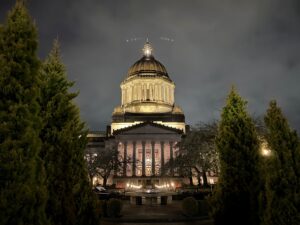
In May 2007, the Washington State Department of Enterprise Services passed rules limiting access to the Capitol dome. Since then, only top agency officials and the Washington State Patrol have been permitted to ascend to the top of the dome.
(Photo Courtesy: Erica Hallock)
At 287 feet, the legislative building is the tallest masonry dome in the United States and among the tallest in the world.
However, a new provision passed in the 2025-27 biennial capital budget will allow up to 10 legislators a year to visit the top of the dome, guided by the DES director. Legislators have sparsely been able to visit the top of the dome, if at all, this century. Limitations on accessing the dome were first put into place in 1996, and following the Nisqually earthquake in 2001, repairs had to be made which extended into 2004 with further restrictions on access. With the dome itself weighing 30.8 million pounds, it’s reasonably imperative to ensure that visitors remain safe in trekking upward to the highest point of the building.
The steep, narrow spiral staircase from the 4th floor to the top of the dome is the source of health and safety concerns that prompted restrictions on access. A total of 266 metal steps to the top; the route poses challenges to climb, navigate, and in the case of emergency, to evacuate.
If you’re still curious about what the inside of our state’s capitol dome looks like, check out this video documenting the climb to the top.
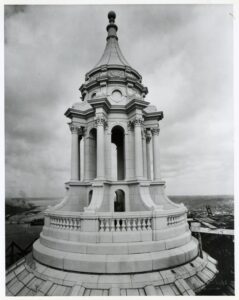
The Cupola and lantern atop the dome of the Legislative Building by Joseph William McKnight, 1926
(Photo Courtesy: Washington State Archives)
At over 250 feet high, the view of Olympia from the Cupola seems to be quite a sight. If given the opportunity, would you make the climb?
The answer for me is easy – yes. But I would need time to catch my breath! If you have “made it to the top” and have pictures, we would love to see them.