

POTATO DAY!!
(Photo Courtesy: Erica Hallock)
Trivia!
In May 2025 a new bronze marker was added to the Capitol campus commemorating the campus’ original designers. Who were these original designers?
Highlights of the Week
Potato Day!
The best way to turn a rainy Monday frown upside down is clearly Potato Day! Sponsored by the Washington State Potato Commission, the concept of “potato day” is simple – the fine folks from the Potato Commission offer up free baked potatoes with all the fixings.
And the people come – in droves! Lines started forming around the third floor of the Legislative Building for the free taters as early as 10:30 a.m. For a brief moment, there was joy in Olympia…
Policy Committee Cutoff
As we’ve been reporting, Wednesday, February 4 represented the House of Origin Policy Committee cutoff. These cutoffs serve as deadlines for bills to remain viable. As noted in last week’s Notes From Olympia, bills deemed Necessary to Implement the Budget or “NTIB” are exempt from cutoff deadlines.
For the first part of the week, policy committee agendas were packed with executive sessions full of debate and consideration on a slew of amendments. If you are following a particular bill, be sure to check the latest version on the legislative website as there’s a good chance its direction may have changed.
House Bill to Establish Child Care Workforce Standards Board Receives Hearing in House Appropriations Committee
Bills introduced in the first year of a two-year legislative session are eligible for consideration in the second year. HB 1128 (Fosse) represents one of these bills.
Scheduled to be heard in the House Appropriations Committee shortly after this newsletter hits your inbox on Friday morning, the committee is expected to consider a proposed second substitute bill. According to amendments posted on the legislative website on Thursday, February 5, the proposed second substitute would:
- Modify the purpose and scope of the Child Care Workforce Standards Board by requiring the Board to make recommendations on minimum compensation and employment standards, rather than adopting enforceable minimum compensation and employment standards.
- Remove the provisions pertaining to: setting minimum standards and conducting rulemaking; application and scope of rules; training and certifying worker organizations to conduct training; notifications to workers; anti-retaliation protections; and administrative enforcement and the private right of action.
- Require the Board to meet quarterly and make recommendations to the Department of Labor and Industries that will enhance and improve the employment standards of child care workers.
- Require the Board to prepare a series of reports with findings and recommendations, and make those reports publicly available on the Department of Labor and Industries’ website.
- Require the Board, when making recommendations, to prioritize child care worker staffing, recruitment, retention, and staffing ratios.
- Allow the Board to investigate the following: the adequacy of wage rates and compensation policies to ensure the provision of quality services and sufficient levels of recruitment and retention of child care employees; the adequacy of the role of child care employees in making decisions affecting their wages and working conditions; the adequacy and enforcement of training requirements for child care employees; the impact of systemic racism and economic injustice on child care employees and the adequacy of efforts to alleviate such impact through the development of career paths through partnerships between labor and management and other methods; and the adequacy of payment practices and policies of the state as such practices and policies relate to the reimbursement of child care employers for the provision of services under a child care program.
- Adjust deadlines by one year to account for the second year in the biennium.
HB 1128 has been scheduled for executive session (vote) in House Appropriations on Monday, February 9.
Town Halls
Many legislators are slated to be back in their home districts or plugging in remotely over the coming weeks for mid-session town halls. Lawmakers will be sharing updates on the bills they’re working on and priorities for the remaining weeks of session, answering questions, and hearing from their constituents. You can find your legislative district here and a list of town halls with House & Senate Democrat members here.
House and Senate Republicans have not yet announced mid-session town halls, but we encourage you to check on their respective news and events pages for future town hall announcements.
What’s on Deck for Next Week?
Quick Pivot to Fiscal Cutoff
Immediately following Wednesday’s Policy Committee cutoff, attention shifted to fiscal committees in advance of the Monday, February 9 fiscal committee cutoff. Despite the long-standing admonition that the state does not have available funding for new investments, lawmakers still introduced legislation that would cost the state money.
With the Seahawks in the Super Bowl on Sunday (GO HAWKS!), the committee schedule was carefully curated to avoid Sunday committee meetings. Members of the House Appropriations Committees will need to prep their tailgate fare on Sunday as they are scheduled for a Saturday committee meeting. The Senate Ways and Means Committee had their Saturday session canceled to give them time to hit Fred Meyer and get their seven-layer dips ready.
“Working the Doors”
Following the February 9 House of Origin Fiscal Committee cutoff, the action on the Capitol campus will shift to the Legislative Building as the Senate and House of Representatives will be in their respective chambers debating and voting on bills prior to the February 17 House of Origin cutoff. Again, this is another mile marker on the road to Sine Die (end of session). All bills (except those deemed “NTIB”) must be passed by their House of Origin by this February 17 date.
This floor time can feel endless with lawmakers spending hour upon hour in their private caucus meetings discussing the merits of bills they are about to address on the Floor. It is not the most comfortable time for lobbyists as we wait for these same endless hours to try and get the attention of a legislator. This process is called “Working the Doors” as lobbyists gather outside the Senate and House doors waiting for lawmakers to respond to a handwritten note (or text) to come off the Floor to discuss a time sensitive item. The legislator may come right out, but often we wait and wait. It can be quite humbling!
Of course, the Legislative Building is not set up for comfort, and all of the standing around on unforgiving marble floors can really do a number on the body. I happened upon these Japanese wearable beanbags available for purchase online, and I am tempted. It would make this upcoming time period much more bearable.
Bills, Bills, Bills
Millionaire’s Tax Bills Introduced and Hearing Scheduled
On Tuesday, legislative Democrats introduced the much-anticipated “Millionaire’s Tax.” SB 6346 (Pedersen) / HB 2724 (Fitzgibbon) would establish a 9.9% tax on those who earn more than $1 million a year. Bill sponsors estimate the tax would apply to fewer than 0.5% of Washingtonians and would bring in an estimated $3.7 billion a year.
The Senate bill will be heard in the Senate Ways and Means Committee on Friday, February 6 at 1:30 p.m.
For full details, check out this Washington State Standard article.
Will We Get an Official State Shark??
Because the introduction of new bills has slowed dramatically, there weren’t any new bill titles that caught my eye, so this week’s “interesting bill title section” features an update on a bill discussed earlier in the session.
HB 2447 (Reeves), which would designate an official state shark (the bluntnose sixgill shark if you are curious), received an executive session on Wednesday, February 4 in the State Government and Tribal Relations Committee.

Apparently, this a bluntnose sixgill shark (Scary!)
“Jaws” traumatized me as a child, so no deep dive on the bluntnose sixgill shark, but there’s a hyperlink above if you wish to do your own research.
As a reminder, each Thursday, Start Early Washington updates its bill tracker with the latest information on bills we are following. If we have missed any bills of interest, please reach out and flag them for us!
Trivia Answer!
The Capitol Campus’ grounds were designed in the 1920s by the Olmsted Brothers landscape design firm.
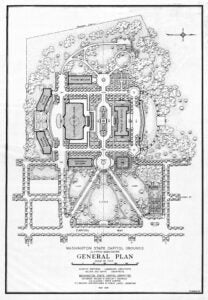
(Photo courtesy: Frederick Law Olmsted National Historic Site via the Washington State Department of Enterprise Services)
Founded by the legendary American architect Frederick Law Olmsted, Sr. (1822-1903), the Olmsted Brothers design firm contributed to the beauty of our nation’s capitol campus in D.C., as well as 12 other state capitols including Washington.
In honor of the original designers, the Department of Enterprise Services (DES) installed a new bronze marker commemorating the Olmsted legacy. DES staff proposed the idea of the plaque, and it was unanimously approved by the State Capitol Committee in 2024. This last May the plaque and marker were installed to the west of the Tivoli Fountain.
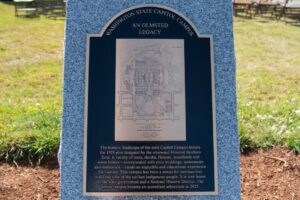
(Photo Courtesy: Department of Enterprise Services)
One of the notable hallmarks of the “Olmsted Approach” is the Genius of Place, which requires taking full advantage of the unique characteristics of a site. The state capitol’s location atop a bluff was intentionally central and celebrated in the Olmsted Brothers design of our capitol campus. The use of the diagonal lines, boulevards, and traffic circles around key monuments and focal elements such as the Dome also speaks to the features of the Olmsted Approach’s Orchestration of Movement to “subtly direct movement through the landscape.”
To read more on the hallmarks of the “Olmsted Approach,” check out this article from the Olmsted Network.
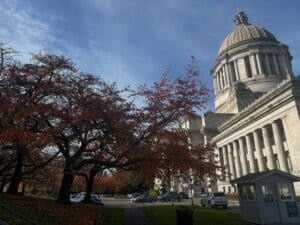
(Photo Courtesy: Erica Hallock)
We speak of the Legislature as “The People’s House” and not dissimilar to any other home, the open outdoor spaces, greenery, and placemaking elements are what really transform structures into homes and buildings into gathering places.
The next time you are taking a stroll around the capitol campus, take a moment to appreciate the true beauty of its design and how it has upheld over a century of community gathering, celebration, and demonstration of the people’s will.
Sources
New marker commemorates Olmsted design vision – Washington Department of Enterprise Services
Olmsted Legacy Marker – Washington Department of Enterprise Services
Olmsted Brothers: Original Landscape Designers – Washington Department of Enterprise Services
Frederick Law Olmsted: His Design Principles – Charles E. Beveridge, The Olmsted Network
GO SEAHAWKS!