
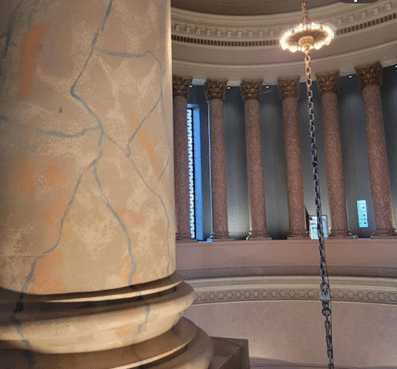
A Look Inside the Capitol Dome*
(Photo Courtesy: Washington State House Democrats)
Trivia!
One last tangentially related football trivia for the year…
What did longtime Lt. Governor John Cherberg teach in high school prior to becoming a football coach at the University of Washington?
Highlights of the Week
Fiscal Committee Cutoff
After five quick – but grueling – days following the February 4 Policy Committee Cutoff, Monday, February 9 served as the Fiscal Committee Cutoff.
The Senate Ways and Means Committee did not meet over the weekend, leaving a hearty 69 bill agenda on Monday. Even with the contentious “Millionaire’s Tax” as one of those 69 bills, the committee managed to conclude its business by a decent hour on the Fiscal Cutoff date.
The Senate Ways and Means Committee approved the Millionaire’s Tax on Monday (SB 6346) after adopting amendments proposed by the prime sponsor, Senator Jamie Pedersen. You can read all of the details from the Washington State Standard. Following the committee’s vote, anti-tax activist Tim Eyman stood up to personally address the Committee. His out-of-order remarks were met by an escort out of the room from Senate Security. The bill was pulled out of the Senate Rules Committee on Thursday, February 12 and is now eligible for consideration on the Senate Floor.
The House Appropriations Committee ran long on both Friday and Saturday evenings and concluded their work on Monday as well. In a preview of challenging budget decisions likely coming our way, the House Appropriations Committee adopted an amendment to HB 2688 (Gregerson) in their Saturday evening meeting that would take funding levels for the Early Support for Infants and Toddlers program down to 2008 levels.
As a reminder, each Thursday, Start Early Washington updates its bill tracker with the latest information on bills we are following. If we have missed any bills of interest, please reach out and flag them for us!
“Floor Time”
Attention turned to the Senate and House chambers Tuesday as both bodies focused on the long list of bills awaiting action before the February 17 House of Origin Cutoff. While it is not unusual for this “Floor Time” to extend into the early morning hours (particularly in the House), both the Senate and House eased into floor session activity and largely avoided late night action. I expect that to change in the House the closer we get to the February 17 House of Origin cutoff date. The Senate generally prefers to conclude their business at a reasonable hour and get home. I respect that approach.
While tempted, I did not purchase the wearable beanbag mentioned in last week’s newsletter. Yet.
Caseload Forecast
On Wednesday, February 11 the Washington State Caseload Forecast Council met to receive the latest projected caseloads (expected enrollment and participation) for state entitlement programs such as K-12 education, long-term care, and prisons. The Caseload Forecast is an important benchmark for legislators in drafting House and Senate budget proposals as the forecast directs how much the state must spend on various entitlement programs.
These forecasts are predicated on current law and policy, meaning they do not reflect any legislation currently being considered by lawmakers this session. The November forecast included updated projections based on legislation passed in 2025 as well as impacts of H.R. 1 as we understand them to date. Currently, the greatest risks to the predictability of forecasts across entitlement programs are immigration enforcement activities and general economic conditions.
One of the summary documents prepared by the Caseload Forecast Council breaks down where state program forecasts came in higher, lower, or negligible/unchanged from the previous forecast in November. In tight budget times, “lower than” and “unchanged/negligible” forecasts are preferable over those higher than the previous forecasts.
Programs forecasted in February to have higher caseloads than the previous forecasts will in turn drive higher costs for the state budget. The DOC Community Custody Violators, College Bound Scholarship, and Extended Foster Care programs have the highest increases from the November forecast with 15.4%, 10.7%, and 7.9% increases in their forecasts respectively. The Community Custody Violator program’s increase is based on a policy change that restored 30-day maximum confinements for high-level violations. The College Bound Scholarship program increase is in part due to soft labor market conditions for younger people and an increase in the number of pledges meeting income eligibility. Extended Foster Care caseload increases are following a similar, but delayed, trend as seen in Licensed Foster Care.
Early Learning Caseloads
Early Childhood Education and Assistance Program
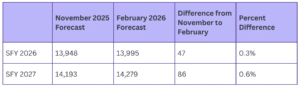
Early Childhood Education and Assistance Program (ECEAP) caseloads were unchanged/negligible for the second forecast in a row. Funded slot utilization reached roughly pre-pandemic levels in the early part of the 2025-26 school year and now enrollment has been closer to funded capacity for the current school year. This forecast does not reflect the impact of the anticipated Ballmer Group investment since the PreK Promise Account is still under consideration. Following the passage of HB 2159 / ESB 5872, the June 2026 Caseload Forecast would reflect the projected impact.
Working Connections Child Care
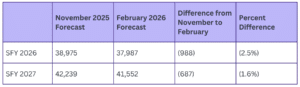
Working Connections Child Care (WCCC) caseloads are projected to be lower than the November forecast due to step adjustments modeling the caseload impact of ESSB 5752 copayment schedules, prospective payments, and the repeal of expanded eligibility for child care employees.
Transition to Kindergarten
Transition to Kindergarten (TTK) also has an unchanged/negligible forecast because its caseload is capped by funding in the 2025-27 biennial budget. Its caseload remains at 7,266.
Town Hall Reminder
Many legislators are slated to be back in their home districts or plugging in remotely in the coming weeks for mid-session town halls, with several slated for February 21. Lawmakers will be sharing updates on the bills they’re working on and priorities for the remaining weeks of session, answering questions, and hearing from constituents. You can find your legislative district here and a list of town halls with House & Senate Democrat members here.
House and Senate Republicans have not yet announced mid-session town halls, but we encourage you to check on their respective news and events pages for future town hall announcements.
What’s on Deck for Next Week?
Revenue Forecast Scheduled for Release on Monday
A reminder that the Washington state legislative clock runs for 60 days in even-numbered years, including weekends and federal holidays. This session has, and will, feature a lot of weekend activity, and the Legislature always works on federal holidays. A large benefit of “being open for business” on the federal holidays is the ability for Washingtonians who have a day off to come to the Capitol to advocate for issues of import.
This Monday, Presidents Day, the state’s updated Revenue Forecast is scheduled for release at noon. This highly anticipated report prepared by the state’s Chief Economist provides the official forecast of the state’s revenues. It takes into account revenue collections; potential impacts of global and national events on the state’s economy; and includes optimistic and pessimistic projections.
The last Revenue Forecast in November 2025 projected a $2.3 billion shortfall in the 2025-27 biennium. This February 16 Revenue Forecast will provide an updated number and will be used to inform the Senate and House budget proposals that will be released shortly thereafter.
House of Origin Cutoff – Guesses on the 5:00 Bill?
Our next cutoff deadline will arrive on February 17 at 5:00 p.m. Legislative leadership often schedules a controversial bill in each chamber as the so-called “5:00 bill.” This is because if debate starts before 5:00 p.m. on the House of Origin cutoff, it can last as long as necessary. Scheduling a controversial bill for this time slot is a strategic decision not to use precious floor time on a bill that would “gobble up” time and end up killing other good bills because there’s not enough clock time.
So, what will the 5:00 bill be next week? If I were a betting person (which I’m not), I’m going with the Millionaire’s Tax in the Senate. I’m not sure about the House. What’s your guess?
Dairy Day!
If you are looking to come to campus next week, Dairy Day is scheduled for Wednesday, February 18. Another favorite, unless you are lactose intolerant.
Trivia Answer!
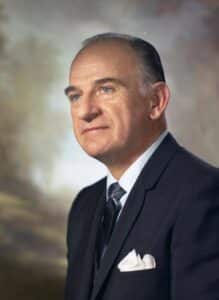
The Late John A. Cherberg
1910 – 1992
(Photo Courtesy: Wikipedia)
TYPING! Believe it or not, typing used to be an actual class that many of us (including the author) took in high school on actual typewriters.
My guess is Lt. Governor Cherberg taught many a student the importance of inserting two spaces after a period (never giving that up!) and oversaw countless timed typing tests (I may have started to sweat a bit remembering those).
Although Cherberg did teach typing, he was most known as a football coach prior to entering politics. A former football player himself (his nickname was “Cowboy” on the football field for Queen Anne High), he went on to play for the University of Washington as a halfback. As a teacher and coach, Cherberg led Cleveland High School to the all-City football championship in 1937 (beating Garfield 2-0!) and then returned to his alma mater Queen Anne High to coach football and teach.
In 1953, Cherberg was hired as the head football coach at the University of Washington. His time leading UW was short as he was released after a 10-18-2 record and various concerns (let’s just say some of the “pay to play” conversations in collegiate sports we hear today do not appear to be new).
Building on his name recognition through his connection to the University of Washington football program, Cherberg made his first run for elective office in 1957. He defeated a fellow Democrat in the Lt. Governor primary and went on to defeat a Republican in the November general election. For the first 15 years in office, he also worked as an account executive for Seattle’s KIRO TV to supplement the paltry Lt. Governor salary.
Cherberg went on to serve as Washington state’s Lt. Governor for 8 consecutive terms – 32 years. At the time when he stepped down in 1988, he had been the longest serving Lt. Governor in any state’s history and had served in that role for almost one-third of Washington’s existence.
As Lt. Governor, Cherberg was known for his ability to preside over the State Senate in a fair manner as well as for his deep knowledge of parliamentary procedure. He was also known as a stickler for decorum. In my research, I read one story of how he admonished one Senator in the 1970s for wearing casual pants on the Senate Floor. I really wish that story had been accompanied by a picture.
In 1985, the former “Senate Office Building” was named to honor John A. Cherberg. Today, it is commonly referred to as “JAC” or “Cherberg.” I will look into the history of the actual building in a future newsletter. While racing through there earlier this week, I did pause and look at the display case on the south side that has memorabilia honoring Lt. Governor Cherberg. There were football references, but no typewriter.
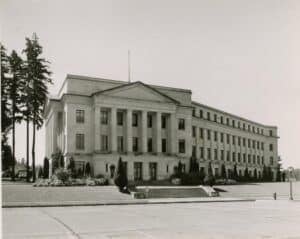
John A. Cherberg Building (AKA “JAC”) in 1950
(Photo Courtesy: Washington State Archives)
Sources
Thurston County Trivia Game
*Trip Up to the Top of the Legislative Dome
In the January 23 Notes From Olympia, we wrote about how up to 10 legislators a year will now have access to venture to the top of the Legislative Dome.
Per the Washington State Democrats Instagram account, House Speaker Laurie Jinkins and House Capital Budget Vice Chair Lisa Callan recently made the trek to the top of the Dome.
In addition to the picture that opened this week’s newsletter, the Washington State Democrats shared the following breathtaking pictures on the Instagram account:
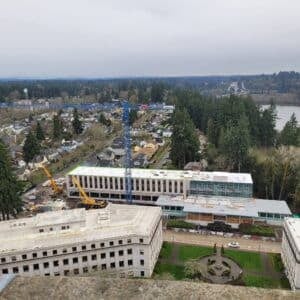
A personal note. I have been mesmerized by the blue crane shown in the picture above that has been in operation since the start of the 2025 legislative session during the renovation of the Pritchard Building on the Capitol campus. Apparently, I missed the memo that the crane’s work was complete and it was removed on January 31. No more diversion of watching heavy items being moved through the area to distract from a stressful budget year.
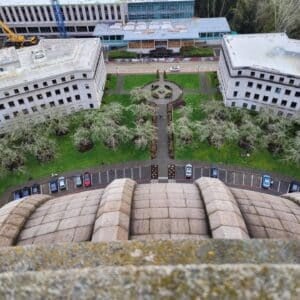
(Photos Courtesy: Washington State Democrats)