Skip to content

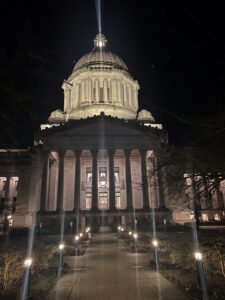
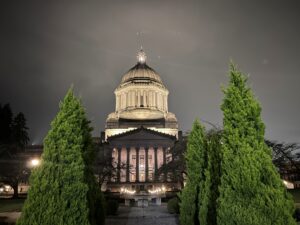
Photo of the Capitol Building in Olympia, Washington in the early morning before the sunrise from Winter 2025.

The fog has lifted at the start of Week Three. Is that a good omen?

(Photo Courtesy: Erica Hallock)

Trivia!

Which legislator is the only member to serve during the two times the House of Representatives was evenly split with 49 Democrats and 49 Republicans?

Bonus Question: How many years apart did this occur?

Governor Ferguson Budget Reduction Target Exercise Instructions Released

On January 24, Office of Financial Management (OFM) Director K.D. Chapman-See released instructions to state agencies regarding Governor Ferguson’s directed budget reduction target exercise.

The instructions direct agencies to identify reductions of at least six percent beyond any reductions included in Governor Inslee’s budget proposal. This means we could see items that agencies originally included on their reduction lists from last November but were not a part of Governor Inslee’s budget reemerge.

Programs providing cash benefits to Washingtonians as well as the following agencies are excluded from this exercise: K-12, community and technical colleges, Washington State Patrol, the Department of Corrections and the Criminal Justice Training Commission. Four-year public universities are asked to identify at least three percent reductions.

In addition to suggestions for potential reductions such as pausing legislative reports, the instructions suggest consolidating management positions (10-25% within each agency) and reducing “administrative, executive, and externally focused positions that are not essential to the delivery of government services (10% to 25% within each agency).”

Agency recommendations are due to OFM by February 6 and will be posted on the OFM website following review.

Highlights of the Week

House Appropriations Receives Early Learning Staff Briefing

On Wednesday, January 29, the House Appropriations Committee received a staff briefing about early learning programs. This presentation is filled with rich data detailing early learning caseloads and investments over the years, highlighting changes since passage of the Fair Start for Kids Act.

Fiscal committees in both chambers are holding these types of briefings and work sessions to prepare themselves for the difficult budget decisions ahead.

Legislative Leadership Media Availability

Each week during the legislative session, legislative leadership holds media availability. These sessions aren’t very long, and they are good to watch to get a finger on the pulse of what is “on top” for that moment. It’s also helpful when you are knee-deep in an issue to pull back and look at the larger landscape.

Not surprisingly, the state budget dominated this week’s leadership media availability. For example, Democratic leaders spoke of how they are busy working on various scenarios but are waiting for the next revenue forecast in March to make more definitive public pronouncements.

I wanted to flag the Republican leadership media availability because child care was one of the first questions asked and Senator John Braun talked about his SB 5310, which will be heard on Monday, February 3 in the Senate Ways and Means Committee (starts around minute 6). Senator Braun’s bill would change the reimbursement rate for Working Connections Child Care to the lesser of the 75th percentile of the Market Rate Survey or a provider’s rate for a private pay family.

What’s on Deck for Next Week

First off, it will finally not be January. For me, January felt like it went on for 97 days.

Committee action continues at a brisk pace. Bill introductions are beginning to slow down slightly, and we are at the stage of heavy public hearings and the start of executive sessions (votes). This is also the time where we are watching for amendments (substitutes) and fiscal notes (expected costs for implementation). In short, things are moving FAST!

As a reminder, each Thursday, Start Early Washington updates its bill tracker with the latest information on bills we are following. If you would like us to do a deeper dive on a particular bill in a future newsletter, let us know!

Tuesday, Feb 4: Senate Early Learning and K-12 Education Committee Hearing on Cost of Quality

  • The Senate Early Learning and K-12 Committee will hear SB 5500 (Alvarado). This bill would modernize the way the state reimburses child care rates to more fully account for the true cost of doing business.

Tuesday, Feb 4: House Early Learning and Human Services Committee Hearings on Provider Qualifications and Child Care Licensing

  • HB 1648 (Dent) would delay the requirement for child care providers to meet certification and training qualification conditions until at least August 1, 2035. It would also add a work equivalency option as an alternative to certification requirements for all child care positions.
  • HB 1582 (Caldier) seeks to make changes to child care licensing requirements so the calculated occupancy load of existing buildings with more than one use (such as churches), would only be based on the space where the child care is provided. The intent of the bill is to leverage existing buildings for child care space.

Thursday, Feb. 6: Senate Ways and Means Hearing on Early Learning Facilities Bill; House Education Expected to Hold Executive Session on Transition to Kindergarten Bill; and House Appropriations Committee Hears Proposal to Push Out Fair Start for Kids Act Provisions

  • The Senate Ways and Means Committee will hold a public hearing on SB 5297 (Trudeau/Torres). This is the Senate companion to HB 1314 (Callan/Abbarno) which was heard in the House Capital Budget Committee this week. It would make technical changes to the Early Learning Facilities Fund.
  • HB 1450 (Santos) is scheduled for an Executive Session (vote) in House Education next week. In the public hearing this week on the Transition to Kindergarten Bill, Representative Santos stated she plans to propose a substitute bill with changes.
  • Finally, the House Appropriations Committee will hold a public hearing on HB 1489 (Ormsby). This bill adjusts implementation dates for Working Connections Child Care income eligibility and ECEAP entitlement created through the Fair Start for Kids Act to align with former Governor Inslee’s proposed regular budget.

Friday, Feb 7: House Labor Committee Action Scheduled on Child Care Workforce Standards Board and House Finance Committee to Consider Sales Tax Removal on Diapers

  • The House Labor and Workforce Standards Committee has scheduled an Executive Session for HB 1128 (Fosse) related to the establishment of a Child Care Workforce Standards board. Refer to the January 17th Notes from Olympia for a more detailed summary of that.
  • Last week I highlighted the various efforts to ease some of the affordability challenges facing Washington families. Two bills in this area are scheduled for hearings next Friday in the House Finance Committee. The first, HB 1307 (Caldier), would remove the sales and use tax on diapers and other essential child care products. The second, HB 1318 (Rule), is narrower and would remove the sales and use tax, but only for diapers. It will be interesting to watch how this conversation advances.

Trivia Follow-Up Items

After last week’s focus on the Pritchard construction project, Monday saw the timely introduction of House Concurrent Resolution 4403, which would officially rename the Joel Pritchard State Library to the “Joel Pritchard Building.”

The resolution cites a desire to reduce confusion for campus visitors as a main rationale for the name change, since the building no longer serves as a library. The resolution also – of course – references Pritchard’s love of pickleball.

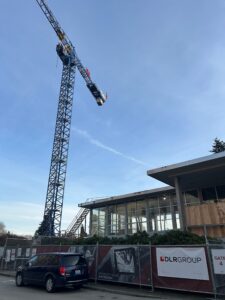
I was not kidding about my fascination with the 188-foot crane moving big items for the Pritchard project. I stopped one of people working on the project this week to ask about the required training to operate the crane and was told it involves a four-year apprenticeship! The operator also has to climb up a 188-foot ladder each day to operate the crane. It is a dangerous job, so it looks like I will have to stick with writing this newsletter while I watch the crane transport large items around the construction site.

Trivia Answer

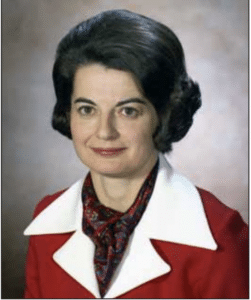
Former Representative Helen Sommers from the 36th Legislative District is the only legislator to have served during the two times that the House of Representatives was evenly split between Democrats and Republicans.

Bonus Question: 19 years! The first tie was in 1979 and the second tie was in 1998.

Portrait of former Washington State Representative Helen Sommers.

Representative Helen Sommers
Served in the House of Representatives from 1972-2008

(Photo Courtesy: Helen Sommers: An Oral History)

Former Representative Sommers has a tremendous legacy and I plan to devote a future trivia to her story.

Co-Speakers

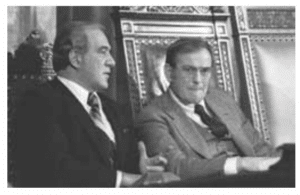
After the Republicans picked up 13 seats in the 1978 election, the body was split evenly with 49 D’s and 49 R’s. Since there was no precedence for what to do in this situation, the body opted to select co-speakers. The Democrats selected Representative John Bagnariol (known as “Baggie”) from Renton to serve as their co-speaker and the Republicans selected Representative Duane Berentson from Burlington to represent their caucus. (My internet sleuthing did not uncover a clever nickname for Representative Berentson.)

The co-speakers decided to preside on alternating days, selected co-chairs for the seven “most important” committees and divided the remaining 14 committee chairs evenly between the two parties. They also decided that no big decisions would happen without the engagement of both parties.

Photo of Washington State House of Representatives Co-Speakers Jon Bagnariol and Duane Berentson inside the House Chamber, taken in 1979.

Washington House of Representatives Co-Speakers Jon Bagnariol and Duane Berentson
Olympia, 1979

(Photo Courtesy: Six Speakers of the House)

The second tie occurred following the 1998 election. This time, Democrats selected Representative Frank Chopp of Seattle to be their co-speaker and Republicans chose Representative Clyde Ballard of Wenatchee. (Fun Helen Sommers fact: during this time Representative Sommers served as the Co-Chair of the House Appropriations Committee.)

A 2001 special election gave House Democrats the majority and Representative Chopp went on to become the sole Speaker. Many Olympia followers are well aware that Representative Chopp would go on to be the longest serving Speaker of the House until he stepped down from that role in 2019 and then retired from the Legislature in 2024.

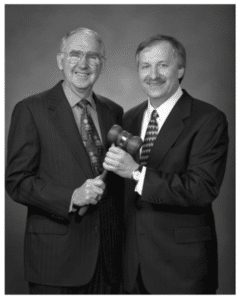
In both instances, a two-handed gavel was created for the co-speakers to signal the partnership.

Portrait of Washington State House of Representatives Co-Speakers Clyde Ballard and Frank Chopp holding the two-handed gavel created to signal the partnership of co-speakers.

Co-Speaker Clyde Ballard and Co-Speaker Frank Chopp

(Photo Courtesy: Six Speakers of the House)

Sources:

Helen Sommers: An Oral History; Legislature Oral History Project, Published 2010

Six Speakers of the House; Legislature Oral History Project, No Year Provided

More Like This

Contact Us

Connect with our team to learn more about our work or discuss how we can support policy and advocacy work for your organization.

Email Us

Washington State icon

Washington State Hub

Learn more about our work in Washington state and access relevant resources and publications. 

View Hub

Let's talk icon

Stay Connected

Stay up to date on the latest early childhood policy updates from Olympia.

Sign Up

Photo of the Capitol Building in Olympia, Washington from Winter 2025.

Ready for Week Two…

(Photo Courtesy: Erica Hallock)

Trivia!

The Joel Pritchard Library is the latest building on the Capital campus to be undergoing a complete overhaul. When it reopens in 2026, which legislative chamber will assume offices in the enlarged building?

Photo of the Joel Pritchard Library Building in Olympia in 2014.

The Joel Pritchard Library in 2014

(Photo Courtesy: ThurstonTalk)

Highlights of the Week

The Roster is Complete! Final Legislative Appointments Made and Lawmakers Sworn In

This has been a most atypical year with a high degree of movement with sitting legislators assuming statewide or Congressional office, accepting leadership jobs within the Ferguson administration or timing their retirement so an appointment was necessary. After this week, the Senate and House are both finally back to “full capacity.”

The King County Council appointed early learning and housing champion Emily Alvarado to serve as Senator in the 34th Legislative District, with Brianna Thomas receiving the appointment for Alvarado’s House seat. The Council also appointed Janice Zahn to represent the 41st Legislative District in the House seat vacated by Representative Tana Senn, now Secretary of the Department of Children, Youth and Families.

With the high number of former House members now serving in the Senate, we could start a friendly wager about the number of times testifiers mistakenly refer to these new Senators as “Representative” during their remarks. Change continues to be the theme of 2025.

Senate Fiscal Committee Holds Early Learning Work Session

On Tuesday, January 21, the Senate Ways and Means Committee held a work session on developments in early learning. The committee heard a briefing from committee staff followed by presentations from the Office of the Superintendent of Public Instruction and the Department of Children, Youth and Families. The work session is available to watch on TVW.

Given the work session was in a fiscal committee (and with our state’s budget crisis), you will not be surprised by the questions and discussion focused on budget and costs.

Senate Labor Committee Hears Child Care Workforce Standards Bill

On Monday, January 20, the Senate Labor and Commerce Committee held a public hearing on the Senate vehicle for the Child Care Workforce Standards Bill, SB 5062 (Stanford). We included a more detailed summary of the concept of the Workforce Standards Board in last week’s Notes from Olympia if you want to reference the details.

The bill generated a hearty debate. Check it out on TVW – it is in the first bill in the hearing.

Child Care Siting Bill

On Tuesday, January 21, the House Local Government Committee heard HB 1212 which is prime sponsored by Representative (now Senator) Alvarado. This bill would require that child care centers be permitted as outright uses in all zones except for industrial zones.

Now you may be asking, what happens to this bill with Senator Alvarado in the Senate? The bill stays alive and keeps moving and the second sponsor (Representative Duerr) becomes the prime sponsor.

Notably at the hearing, the Association of Washington Cities Government Affairs staff testified in appreciation for Senator Alvarado’s engagement with the cities over the interim on the development of this bill.

The bill is scheduled for executive session (vote) on Friday, January 24th.

What’s on Deck for Next Week

Tuesday, Jan. 28: House Education Committee Hear Bill on Transition to Kindergarten

  • The House Education Committee will hear HB 1450 (Santos) sponsored by the Committee Chair, Representative Sharon Tomiko Santos. The bill language may be familiar as it closely reflects the 2023 legislation (HB 1550) as it passed the House before it was amended in the Senate.

Tuesday, Jan. 28: Public Hearing on Child Care Notification Requirements and Liability Insurance

  • The House Early Learning and Human Services Committee will hold a public hearing on HB 1282 (Pollet) which makes changes to notification requirements to parents if a program has a change in licensing status; changes regarding what information is to be publicly posted; and directs DCYF to look into liability insurance issues.

Wednesday, Jan. 29: House Fiscal Committee to Review Early Learning Budget

  • Following in the footsteps of their Senate counterparts, the House Appropriations Committee will be looking at fiscal issues around early learning. As in the Senate work session, I will be particularly interested in the committee member questions.

Thursday, Jan. 30: Early Learning Facilities Bill Receives Hearing

  • The House Capital Committee will hear HB 1314 (Callan/Abbarno). This bill aims to make improvements to the Early Learning Facilities Fund program. Check out last week’s Notes from Olympia for a more detailed description of the bill’s contents.

Friday, Jan. 31: House Child Care Workforce Standards Board Bill Scheduled for Vote

  • Friday, the House Labor and Workplace Standards Committee will vote on HB 1128 (Fosse), the House vehicle for the Child Care Workforce Standards Board. This bill was heard in the first week of session.

Bills, Bills, Bills

Bills continue to be introduced at a fast clip, and we encourage you to glance through the bill tracker that we update every Thursday and post on the top of our Policy and Advocacy Resources page. If there is a bill you would like us to do a deeper dive on, send us an email.

Addressing the Affordability Challenge for Families

A flurry of bills have been introduced this session by legislators from both sides of the aisle to address the affordability challenge of raising young children. There are bills to remove sales tax on diapers and “essential child care products” HB 1307 (Caldier)/HB 1318 (Rule). There is even a bill to exempt “permanently from the sales and use tax purchases of products for young children” SB 5341 (Fortunato).

Delaying Implementation of Fair Start for Kids Act

House Appropriations Chair Representative Timm Ormsby introduced HB 1489 (Ormsby) which included former Governor Inslee’s proposed budget proposal to delay two provisions in the Fair Start for Kids Act due to the state’s budget situation. The first would delay the income eligibility expansion for Working Connections Child Care from 60% of State Median Income to 75% of State Median Income from July 1, 2025 to July 1, 2029. The second would extend the implementation date for ECEAP entitlement from the 2026-27 school year to the 2030-31 school year.

When are the Upcoming Legislative Committee Deadlines

In parenting there is an expression that “the days are long, but the years are short.” In the legislative world, time takes on an entirely different pace – you might look at your watch for the first time and realize it is 3:30 p.m. and you haven’t even had a chance to eat anything all day! It is not uncommon for people associated with the legislative process to forget the day of the week. Thank goodness for smart phones.

Time, though, is an important construct of the legislative system as built in deadlines (or “cutoffs”) serve as filters to winnow down the volume of policies that are still eligible for consideration. And bills that do not advance past these cutoffs are considered “dead” in legislative vernacular. Like the English language, there’s always an exception to every rule and we will explain these exceptions in future newsletters.

For now, Olympia’s eyes are on these upcoming deadlines:

Friday, February 21: Policy Committee Cutoff (All bills must be passed out of the policy committee of their house of origin)

Friday, February 28: Fiscal Committee Cutoff (All bills must be passed out of the fiscal committee of their house of origin unless they are considered Necessary to Implement the Budget).

These back-to-back-cutoffs mean fiscal committees will likely be working the weekend of February 22.

Trivia Answer

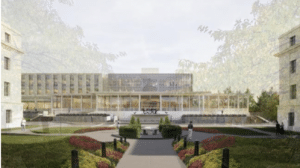
When the renovated – and expanded! – Joel Pritchard Building reopens in 2026, it will contain offices for members of the House of Representatives.

Architect rendering by DLR Group and HBB Landscape of the New Pritchard Library building.

Architect renderings of the New Pritchard Library by DLR Group and HBB Landscape Architecture

(Photo Courtesy: Washington State Department of Enterprise Services)

The Washington Capital Campus is beautiful, but it was not designed to be overly accommodating for the public who might need to find a quiet moment, hold a meeting, get some work done or – in today’s world – need to re-charge multiple devices. The Prichard Library has served as a solace to those of us who spend our days on this campus. We could sit down (seriously there is nowhere to sit on this campus); meet with a group on an issue; take a phone call; grab some food from the deli. With the latest round of construction, this space is gone, and it is impacting campus life. Currently, there is just one spot to buy food – the Dome Deli in the Legislative Building. The campus has not yet been hit with busy lobby days with lots of visitors and those days will no doubt be crowded.

As I researched what is to come with the new Pritchard Building, I was excited to read they will have more of a café like setting (according to the architectural renderings). And I cannot understate this request – MORE OUTLETS. WE NEED MORE OUTLETS. While we are it, let’s bring back phone booths!

Some History on the Pritchard Library Building

Designed by noted architect Paul Thiry, the building was originally designed to host the Washington State Library (hence the name the Pritchard Library). It opened in 1958 and was named after our state’s former Lt. Governor AND founder of pickleball Joel Pritchard. It is on the National Register of Historic Places.

After the 2001 Nisqually earthquake, the Legislative Building was damaged and the main floor in Pritchard was transformed into a temporary chamber for the State Senate. Prior to this renovation, the building housed the Code Reviser and its staff (they write the bills). The building also houses the infamous bill hopper where lawmakers “drop” their bills.

A two-story modular building was installed on the north side of campus when the Newhouse building construction began. It is serving as a rotating “holding space” for legislators and staff impacted by construction and is currently housing the Code Reviser team. Next up in Capital construction will be the John L. O’Brien office building (home of many House of Representative members) as that project is next on the campus improvement slate.

Photo of a 188-foot crane atop the Pritchard Construction Project in Olympia.

There’s a 188-feet high crane atop the project. This week it was transporting a dumpster and groups of people stopped in their tracks to watch. At night it’s lit up in red. It’s an exciting diversion on the Capital campus.

(Photo Courtesy: Erica Hallock)

Photo of demolition waste from Pritchard Construction Project on the Capitol Campus in Olympia.

Bye, Bye Pritchard of Old

(Photo Courtesy: Department of Enterprise Services)

More Like This

Contact Us

Connect with our team to learn more about our work or discuss how we can support policy and advocacy work for your organization.

Email Us

Washington State icon

Washington State Hub

Learn more about our work in Washington state and access relevant resources and publications. 

View Hub

Let's talk icon

Stay Connected

Stay up to date on the latest early childhood policy updates from Olympia.

Sign Up

Photo of the Capitol Building in Olympia, Washington from Winter 2025.

The Proverbial Calm Before the Storm

The Legislative Building on the Morning of Day One

(Photo Credit: Erica Hallock)

Trivia!

Which Washington county is named after our state’s first governor?

Governor Ferguson Releases Budget Priorities for 2025-27

On Thursday, Jan. 9th, Governor Ferguson released a 14-page document outlining his budget priorities for 2025-27.

In an accompanying letter, Governor Ferguson shared his view that the state cannot tax its way out of its budget situation and expressed deep skepticism that Governor Inslee’s “untested” wealth tax could close the budget gap. He notes his team is taking time to review each line of Governor Inslee’s proposed budget, but it is clear the state cannot afford all the proposed expenditures. Governor Ferguson states he will not entertain new revenue options until every effort has been exhausted to increase efficiencies.

Governor Ferguson does propose $800 million in new spending, but places heavy emphasis on overall review of state operations to identify savings and efficiencies. Specifically, he projects savings of $4.4 billion over two biennia through an equivalent 6% state agency-wide cut. (Note these cuts would be in addition to those proposed by Governor Inslee in his budget). Governor Ferguson excludes K-12 and public safety entities from this budget reduction exercise and plans to direct state agencies to identify their own reductions.

Governor Ferguson outlines the following Budget Principles:

  • Avoid legislation that includes spending hikes outside of the four-year budget outlook;
  • Increase the percentage of operating budget funding for basic education;
  • Ensure strong budget reserves; and
  • Support state employees.

Among new spending items, Governor Ferguson proposes the following for the 2025-27 biennium:

  • $100M in new funding for a grant program for cities and counties to hire more law enforcement;
  • $240M to support free school meals for all Washington students;
  • $600M in the Capital Budget for housing related investments; and
  • $100M to support subsidized child care for lower income workers where at least one parent works for a small business.

On a final note, in a cover letter to state legislators accompanying this budget priority document, Governor Ferguson asked each legislator to identify at least one program that is not achieving its intended objective or delivering “meaningful results for the people of Washington,” noting the program could be large or small.

Highlights of the Week

Pomp and Circumstance

The first day of the legislative session began on Monday with a celebration as recently elected (and re-elected) Senators and House members took their oaths of office. Family members and supporters flooded the Capital campus to witness the event.

The week also featured the “passing of the baton” of our state’s executive leadership. On Tuesday, outgoing Governor Jay Inslee provided his final State of the State address where he touted his Administration’s accomplishments while also urging his successor and lawmakers to protect vulnerable Washingtonians as they work through the state’s budget deficit.
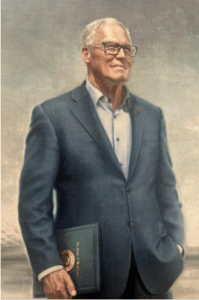
A photo of former Washington State Governor Inslee's (2013-2025) official portrait painting.

Former Governor Jay Inslee’s Official Portrait

Commissioned by the Washington State Arts Commission

Artist: Grace Flott

On Wednesday, the transition became official as Governor Ferguson took the oath of office (and the official website switched over to reflect the change). Governor Ferguson delivered an inaugural speech to a Joint Session of the Senate and House of Representatives. The full ceremony can be viewed on TVW.

Governor Ferguson’s speech struck a different tone than former Governor Inslee’s remarks from the day before. He said he is “… not here to defend government, I’m here to reform it.” He urged an open and honest dialogue about how the state arrived at the budget shortfall and what lessons can be learned. Governor Ferguson stated “I will veto policy bills that defer major spending obligations more than 4 years after the legislation is adopted. These bills violate the spirit of Washington’s requirement that state budgets be balanced over a 4-year period.”

This week also saw a new Secretary of DCYF take the helm. On Monday, Representative Tana Senn took her oath of office as a legislator. Two days later, she assumed the role of Secretary of DCYF after resigning from the Legislature. Similarly, Senator Joe Nguyen resigned his role in the Senate to become the new Director of the Washington State Department of Commerce. Welcome Secretary Senn and Director Nguyen!

Legislative Committee Work Sessions

Legislative committees jumped right into work following the swearing in ceremonies, with the House Housing Committee holding a public hearing on the notable rent stabilization legislation. I could barely make my way into the O’Brien Building which houses the committee hearings due to all the people trying to get into that hearing room.

Both early learning related policy committees in the Senate and House held “work sessions” this week to orient their members to the early learning landscape. Many of these committee members are new to the Legislature or to these issues generally, so these work sessions are great orientations. I personally find these work sessions helpful, both for the data provided by the presenters and for hearing the questions from legislators. I always learn something.

On Tuesday, DCYF’s Allison Krutsinger and Nicole Rose presented an update on Fair Start for Kids Implementation and an overview of the Cost of Quality work. You can watch this work session on TVW, beginning at about the 6-minute mark. Later Tuesday, Krutsinger and Rose made a similar presentation to the House Early Learning and Human Services Committee (this work session is also available on TVW).

In the House Early Learning and Human Services Committee, the DCYF presentation was followed by a panel entitled “Perspectives from the Field” to discuss various aspects of the early learning landscape in more detail. These presenters included Genevieve Stokes of Child Care Aware, Cate Bridenstine of the Imagine Institute, Zamzam Mohamed of Voices of Tomorrow and Maggie Humphreys of MomsRising.

Bills, Bills, Bills

For the past month legislators have been able to “pre-file” bills. On the first day of the legislative session, these pre-filed bills were introduced – and there were a lot of them. For example, the Senate Introduction Sheet on the first day of session listing all the Senate’s pre-filed bills ran 30 pages long! And each day more and more new bills are introduced.

There is added complexity this year in that two legislators resigned to take new roles in the Ferguson administration. For example, with both Senator Nguyen and Representative Senn receiving appointments to the Ferguson administration, government affairs folks have been brushing up on what happens to bills prime sponsored by a legislator that resigns. The answer is these bills remain as introduced bills with the second co-sponsor assuming the role of prime sponsor. The more you know…

You can follow along to the pertinent early learning bills via Start Early’s bill tracker that is updated each Thursday.

The following are some newly introduced bills we thought warranted a bit of a deeper dive.

Early Learning Facilities (HB 1314/SB 5297)

This week, Senate and House companion bills were introduced to make improvements to the Early Learning Facilities (ELF) Fund. HB 1314 (Rep. Callan/Rep. Abbarno) and SB 5297 (Sen. Trudeau/Sen. Torres) would:

  • Make Tribal Compact Schools eligible for the ELF Public School District grant program.
  • Subject to appropriations, establish an emergency grant program for projects that are necessary because of natural disaster or another health or safety threat resulting from unforeseen circumstances.
  • Clarify that projects supporting the conversion of Early Childhood Education and Assistance Program (ECEAP) slots to full day and/or extended full day are eligible for ELF Fund grants.
  • Remove the level of matching funds as a criterion for selecting projects and make other clarifying changes to matching requirements.

HB 1314 and SB 5297 are priorities of the Early Learning Facilities coalition that Start Early Washington convenes. If you have questions or would like more information on this bill, feel free to reach out to me.

Child Care Workforce Standards Board (HB 1128/SB 5062)

HB 1128 (Fosse) and SB 5062 (Stanford) are companion bills that seek to establish a Child Care Workforce Standards Board. The following is a summary of the key provisions of the bills.

Board composition and other details

  • A total of 10 members appointed by Governor.
    • Three members representing child care workers. At least one must be from a list of three or more names provided by the largest organization representing family child care providers, and at least one must be from a list of three or more names provided by the largest organizations representing center workers.
    • Three workers representing child care employers or employer organizations with at least one representing family child care.
    • One member representing a professional development or training program for child care workers.
    • One representative from an organization representing parents.
    • One – Secretary of DCYF (or their designee).
    • One – Director of Labor and Industries (or their designee).
  • Board members serve four-year terms after initial staggered terms. Initial appointments must be no later than September 1, 2025, and the Board’s first meeting, convened and staffed by the Labor and Industries Director, must be held by October 1, 2025.
  • An affirmative vote of five is needed for action. This action includes the establishment of standards.

Role of the Board

  • The Board is directed to adopt rules establishing minimum child care employment standards that are reasonably necessary and appropriate to protect the health and safety of child care workers; ensure child care workers are properly trained about and fully informed of their rights.
  • Standards include compensation and other working standards.
  • Standards are statewide.
  • Board may not adopt standards about licensing.
  • Must adopt rules establishing initial standards for wages no later than 8/1/26.
  • Board must investigate market conditions and existing wages, benefits and working conditions of child care workers for specific geographic areas of the state and specific child care occupations. Using this information, Board must seek to adopt minimum child care employment standards that meet or exceed existing industry condition for a majority of child care workers in the relevant geographic areas and child care occupations.
  • Initial employment standards are effective beginning 1/1/27 and remain in effect until subsequent standards are adopted by rule.
  • Wages do not go into effect if public money is not allocated.
    • If the established child care employment standards result in costs that exceed any applicable federal payments or collective bargaining agreement amounts, the standards are not effective until the appropriation to cover the cost is made.

Worker Trainings

  • Board certifies worker organization provided trainings.
  • The Board is charged with establishing certification criteria; training focus and requirements; and a process for renewal and curriculum requirements.
  • Child care employers must ensure that every two years each of its child care workers must complete one hour of training provided by the certified worker organization.
  • Workers must be compensated for their time taking the training.

HB 1128 received a public hearing in the House Labor and Workplace Standards Committee on Wednesday, January 15th. SB 5062 is scheduled for a public hearing in the Senate Labor and Commerce Committee on Monday, January 20th.

Cost of Quality Care Bill (HB 1350/Senate companion to be introduced)

HB 1350 is the House vehicle for Cost of Quality Care legislation. Representative Emily Alvarado is listed as the prime sponsor, with Representative Julio Cortes as the second sponsor.

The following is a summary of key provisions and background of the Cost of Quality Care bill:

  • The bill is inspired by the work of the Early Education Design Team that included a co-design process involving providers, parent advocates, SEIU 925 and DCYF.
  • The bill would transition the state’s use of the Market Rate Survey to set subsidy rates based on the Cost of Quality Care rate model and protect this transition in statute.
  • The bill includes language maintaining current statute that sets the 85th percentile of market rate as the baseline subsidy rate.
  • The bill does not fully fund the cost of quality care or create a future mandate to do so but puts the tool in place to be revisited by lawmakers in future biennia.

This bill is a priority for the Child Care for WA Roundtable.

A Senate companion bill will be forthcoming.

What’s on Deck for Next Week?

While Monday is a national holiday to honor Martin Luther King, Jr., the Washington State Legislature will be in session. Both the Senate and House of Representatives will hold special floor sessions to honor Dr. King. In past years, bills that typically generated a lot of public testimony would be scheduled for hearing on these federal holidays to allow for maximum public participation. If you are heading to campus next week, be sure to read below about the shuttle services!

Monday, Jan. 20: Workforce Standards Board Public Hearing and Tax Structure Work Session

  • On Monday, January 20, the Senate Labor and Commerce Committee will hold a Public Hearing on SB 5062, the Senate vehicle for the Child Care Workforce Standards Board, at 10:30 a.m.
  • Later that day at 4:00 p.m., the Senate Ways and Means Committee will hold a work session looking at our state’s tax structure.

Tuesday, Jan. 21: Child Care/Early Learning Work Session

  • On Tuesday, Jan. 21, the Senate Ways and Means Committee will hold a work session looking at developments in child care and other early learning programs at 4:00 p.m.

Wednesday, Jan. 22: Executive Session (Vote) on House Workforce Standards Board and House Early Learning and Human Services Public Hearing on Early Learning Provider Qualifications

  • At 8:00 a.m., the House Labor and Workforce Standards Committee is scheduled to vote on HB 1128, the Child Care Workforce Standards Board bill that was heard earlier this week.
  • At 1:30 p.m., the House Early Learning and Human Services Committee will hold a Public Hearing on HB 1082 relating to child care provider qualifications. This bill would give providers until at least August 1, 2028, to demonstrate experience-based competency as an alternative pathway to satisfying qualification requirements.

Visiting the Capital Campus – Shuttle/Bus Service is Here to Help!

Life on the Capital campus is a bit crowded this year with the temporary closure of the Pritchard Building due to construction (more about that in a future newsletter). A long standing problem around Olympia has been parking and if you have been lamenting the demise of the Dash shuttle service, fear not. It is coming back!

If you’ve been on the ground in Olympia the past few years, you may recall Intercity Transit provided the Dash shuttle service between the Olympia Farmers Market and the State Capitol Campus. The shuttle has become a new service route, Route 14, effective January 6th, 2025. Route 14 buses will run from 6:30am to 6:30pm on weekdays, with service every 30 minutes. As a bonus, it’s free, as Intercity Transit does not collect fares from passengers on fixed-route bus lines as part of the agency’s Zero Fare project.

Additionally, the Department of Enterprise Services operates a shuttle service Monday through Friday (including holidays), 6 a.m. to 6 p.m., every 18-20 minutes. The shuttle is a seven-passenger van clearly identified with the DES logo that picks up and drops off state employees and visitors at the following locations:

  • South doors of the Legislative Building
  • Legislative Modular Building
  • General Administration Building visitor parking lot
  • Natural Resources Building visitor parking lot
Trivia Answer

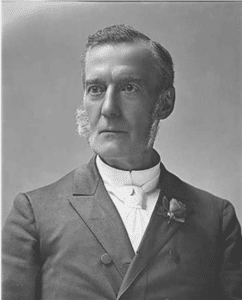
Ferry County is named after our state’s first Governor, Elisha Ferry. Ferry served as Washington’s first governor from November 11, 1889 – January 11, 1893. The county was named for him in 1899.

Black and white portrait of Washington State's first Governor, Elisha Ferry.

Washington State Governor Elisha Peyre Ferry

1825-1895

Tell us a little about Governor Ferry…

Perhaps this information is common knowledge for those of you that grew up in Washington and studied state history in school, but it was new to this Washington transplant. You will not be surprised that my motivation for this week’s trivia was tied to my interest in learning more about gubernatorial inaugurations in our state.

A Republican, Governor Ferry was born in Michigan and was trained as a lawyer. He began his political career in Illinois where he became friends with two notable politicians – General Ulysses S. Grant and Abraham Lincoln. When Grant became President, he twice appointed Ferry as Washington’s Territorial Governor. Interesting to note that Ferry was the nation’s only two-term territorial governor.

When Washington was granted statehood in 1889, voters elected Ferry as the first official governor. He resigned from office in 1893 due to health challenges and died two years later while on a steamer out on the Puget Sound.

Fun fact – Ferry had five children with his wife Sharon Brown Kellogg and all five children were given Ferry’s middle name, Peyre, in honor of his mother’s maiden name.

A Grand Party Honoring Statehood and an Inauguration…Despite the Mud

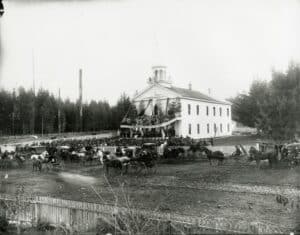
Black and white photo of former Washington State Governor Elisha Ferry's 1889 Inauguration.

Governor Ferry’s 1889 Inauguration

(Photo Courtesy: Washington State Digital Archives)

On November 18, 1889, the city of Olympia hosted a party of epic proportions to honor Washington’s admission to statehood and the inauguration of Governor Elisha P. Ferry.

The event occurred just one week after the state’s admission to statehood, so it is unclear how much time there was to prepare, but records show there was a parade and a ball with music and dancing. The inauguration itself was held at the Territorial Capitol Building (pictured above). According to records, the building was freshly painted and decorated with flags, bunting, flowers and even a “stuffed bald eagle.” (I can affirm no stuffed bald eagles were displayed during this week’s festivities). The Territorial Capitol Building was torn down in 1911 to make way for the current Legislative Building.

Governor Ferry’s full inaugural address was reprinted in the Seattle Post Intelligencer. I’m assuming this was because there was no TVW at that time to share the address with Washingtonians who could not make the trip to Olympia!

In 1889, the celebration included a parade where celebrants lined the streets of downtown Olympia, and the incoming governor was in essence the “grand marshal” making his way to the Territorial Capitol Building for his inauguration. This is one tradition that has not continued, likely as January parades in Olympia would likely be quite damp!

I read that prior to the big party in 1889, the Olympia weather had been very “Puget Sound like” for November. Cold, rainy and wet. And – again – it was 1889, so the streets were not paved. As a result, the parade route was muddy. Participants were already lining up on what is now Capitol Way to catch the festivities when parade organizers decided at the last minute to change the route because of conditions. There were no cell phones or easy ways to share the changes, so word of mouth it was. Folks had to hustle east three blocks (in the mud, presumably) to watch the parade. Good news, the skies were blue that day and, by all accounts, it was a joyous and glorious day as Washingtonians celebrated statehood and its new governor.

Connection to Governor Ferguson

I wrote this week’s Trivia prior to Wednesday’s inauguration and – lo and behold – Governor Ferguson made an Elisha Ferry connection in his inaugural speech! What are the odds?

Governor Ferguson began by sharing that he is a collector of government memorabilia, and he recently purchased an original, signed copy of Governor Ferry’s inaugural address on eBay. He went on to compare our state’s current challenges to those faced by Governor Ferry and that initial Legislature in establishing an entirely new state government. Finally, Governor Ferguson introduced Governor Ferry’s great grand-nephew Tom Kellogg and his wife Kathie who were in attendance for the event.

Sources:

History Link

Washington State Secretary of State

More Like This

Contact Us

Connect with our team to learn more about our work or discuss how we can support policy and advocacy work for your organization.

Email Us

Washington State icon

Washington State Hub

Learn more about our work in Washington state and access relevant resources and publications. 

View Hub

Let's talk icon

Stay Connected

Stay up to date on the latest early childhood policy updates from Olympia.

Sign Up